A snow removal collection agency helps contractors recover unpaid plowing, salting, de-icing and seasonal-service invoices after normal billing efforts have failed.
Snow contractors have a unique problem: the work disappears almost as quickly as the snow does. By the time an invoice is disputed, the parking lot is clear, the storm happened weeks ago, and a property manager may suddenly question whether three pushes were really necessary.
That makes documentation unusually important.
Per-push, per-inch and seasonal contracts all create different billing risks, while commercial clients often expect service dates, snowfall amounts, arrival times and services performed to support the invoice.
CA-USA helps snow-removal companies recover legitimate past-due balances nationwide while keeping the approach professional and relationship-conscious.

Protecting your business reputation, CA-USA performs collections in all 50 states, ensuring a safe approach during every interaction. We provide free litigation and bankruptcy scrubs with zero onboarding or annual fees. Our SOC 2 Type II compliant systems ensure total data security, backed by a 4.85/5 rating from over 2,000 professional reviews. Delivering high recovery rates!
Need a Snow Removal Industry Collection Agency? Contact us
Why Snow-Removal Accounts Become Difficult to Collect
The most common disputes are rarely just:
“I don’t have the money.”
They sound more like:
“That storm wasn’t deep enough.”
“You charged us twice for one snowfall.”
“Salt was supposed to be included.”
“This was a seasonal contract.”
“The property manager never approved that extra lot.”
A collection agency can pursue the balance—but the quality of the contractor’s records often determines how strong that collection file is.
Commercial Property Management Note: Recovering overdue balances requires navigating complex multi-tiered billing structures across third-party property managers, commercial real estate portfolios, and corporate HOAs, which differ significantly from individual residential homeowner disputes.
Need a Collection Agency? Get in Touch with us: |
|
|
|
|
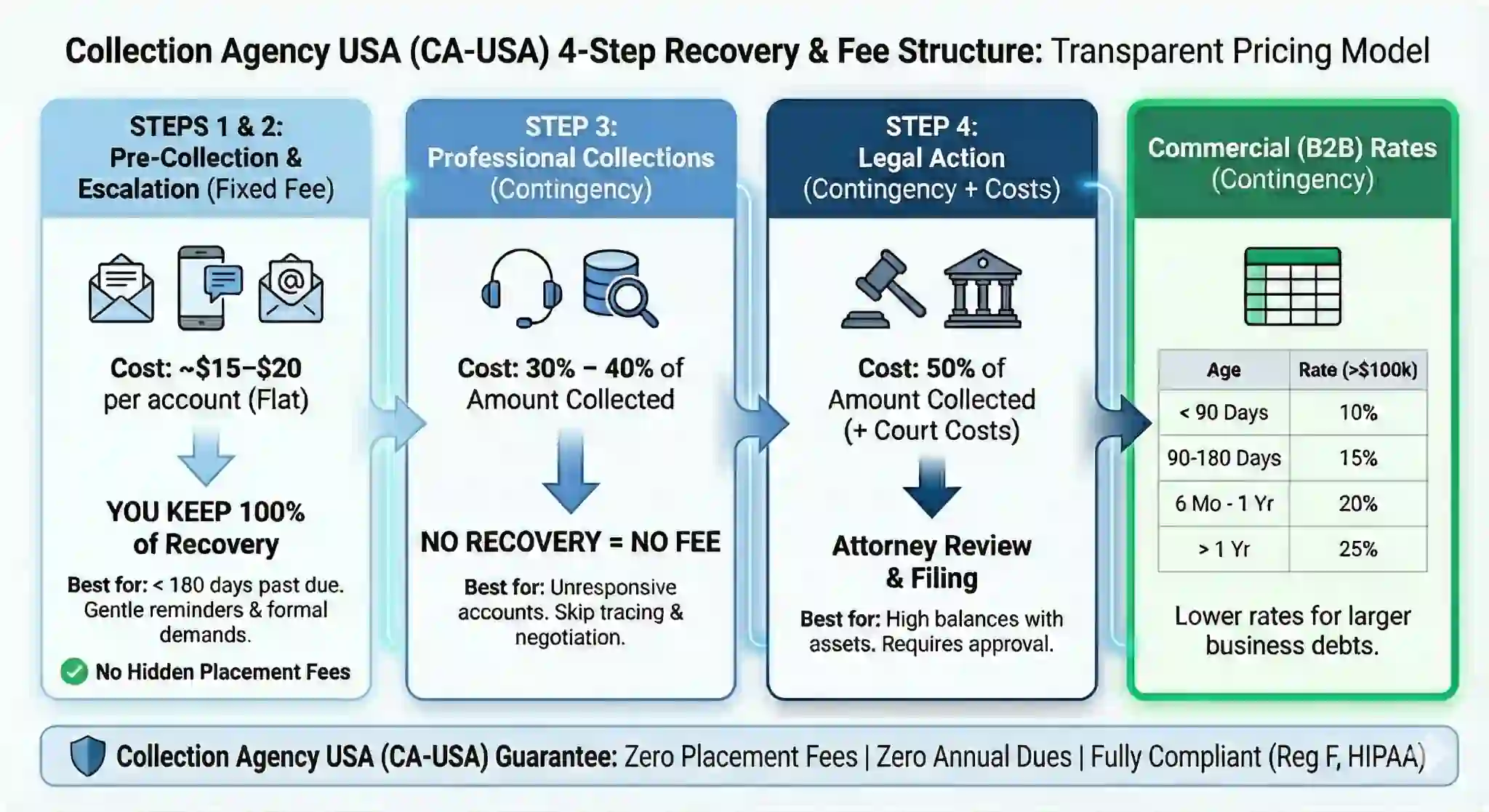
Collection Cost:
Frequently Asked Questions
1. What if the customer says there wasn’t enough snow to trigger service?
Go back to the contract.
If service begins at 2 inches, your records should show the applicable snowfall and when your crew serviced the property. Trigger depth is one of the most important terms in snow-removal contracts because it determines when the contractor is authorized or required to act.
Weather records + service logs + contract terms make a much stronger collection file than “our driver remembers plowing.”
2. Can a customer dispute multiple plow charges from one large storm?
They can dispute them—but that does not automatically mean the charges are wrong.
Long storms may require multiple pushes to keep commercial properties accessible. The contract should explain when a second visit becomes another billable service. Otherwise, a 12-inch storm can quickly become a fight over whether the contractor performed one job or three.
3. What if the property manager says salting was included in the plowing price?
This is exactly why salt and de-icing should have their own clearly defined contract terms.
Snow-industry contract guidance commonly treats salting as a separate service or specifically builds it into a seasonal agreement. If it is separately billed, provide application dates, quantities or service records with the collection file.
4. Our customer signed a seasonal contract but says, “It barely snowed. Why should I pay the full amount?”
Because a seasonal contract generally purchases availability and winter coverage, not a guaranteed number of storms.
In a light winter, the customer may pay more per service event. In a severe winter, the contractor may perform considerably more work for the same seasonal price. That weather risk is part of the pricing model.
If the agreement clearly states a fixed seasonal price, keep the signed contract with the collection documentation.
5. What if our crew cleared an extra entrance or back lot but there is no signed change order?
That becomes harder.
If work falls outside the original scope, written authorization is much better than trying to reconstruct the conversation months later. Industry contract guidance specifically recommends documenting extra work because “just do the back lot too” can easily become “I never authorized that charge.”
Provide texts, emails, work orders, GPS records or other evidence showing who requested the additional service.
6. What records should a snow-removal company keep before sending an invoice to collections?
For per-event work, a strong file should ideally show:
signed contract, invoice, property serviced, service date, arrival/departure time, snowfall or accumulation, plowing performed, salt/de-icer applications, additional services and customer communications.
Detailed storm logs are particularly valuable because commercial clients often compare invoices against weather and service records.
7. Should we wait until spring to send all unpaid winter accounts to collections?
Usually, that is not the best strategy.
By spring, managers change, emails disappear, subcontractors become harder to reach and January’s storm details are no longer fresh in anyone’s mind.
Once normal billing attempts and legitimate disputes have been addressed, earlier placement generally gives the collection agency better information and more current contact data.
Snow melts quickly. Your receivable should not disappear with it.
8. Can CA-USA collect from commercial property managers, HOAs and businesses without burning the relationship?
That should be the goal.
A property-management company may control dozens of future locations. Losing a valuable relationship over one overdue invoice can be expensive.
CA-USA’s commercial approach focuses on documenting the balance, contacting the appropriate decision-maker, resolving legitimate disputes and pursuing payment professionally before considering stronger escalation.
Firm on the balance. Professional with the relationship.
How CA-USA Helps Snow-Removal Companies
CA-USA can assist with delinquent balances from:
- Commercial properties and shopping centers
- Property management companies
- HOAs and multifamily communities
- Industrial and logistics facilities
- Schools and institutions
- Residential customers
- Seasonal and per-push contracts
Services can include skip tracing, bankruptcy screening, business credit reporting where appropriate, a dedicated account representative, secure account management and nationwide collection support.
For suitable newer accounts, CA-USA also offers a $15 fixed-fee collection option, where the debtor pays the creditor directly. Older or more difficult accounts can be handled through 40% contingency collections, with a fee charged only when money is recovered.
Final Thoughts
Snow-removal collections usually come down to three questions:
What did the contract require?
What work did you actually perform?
Can your records prove it?
When those answers are clear, a past-due snow-removal invoice becomes much easier to pursue.
You handled the storm. CA-USA can help handle the unpaid balance. Contact us