• Skip to main content
  • Skip to primary sidebar

Collection Agency

  • Home
  • Cost
  • Contact Us for Collections

collections

by

Collection Agency for Medical Supply & DME Firms: Reputation Safe

collection agency for medical supply distribution companies

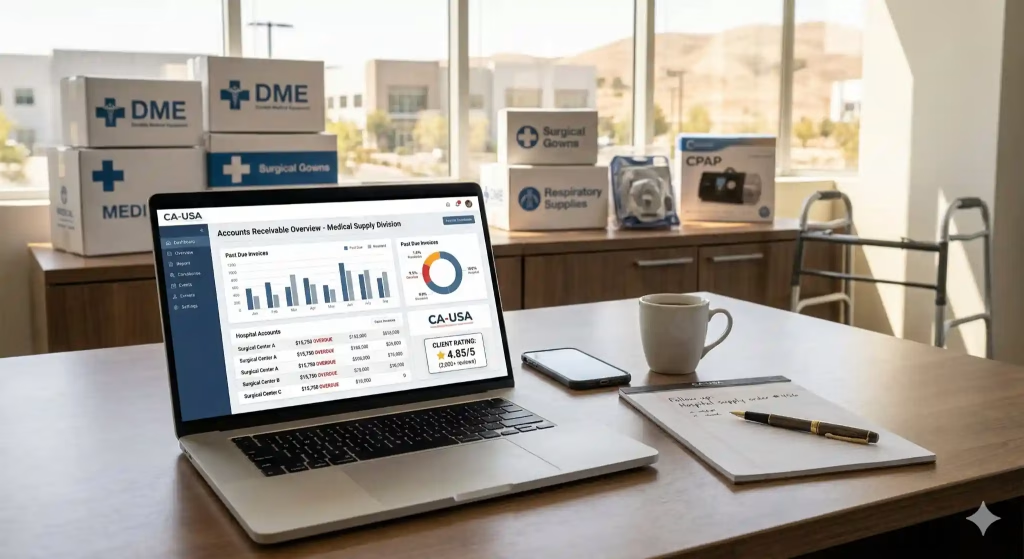
In the high-stakes world of medical supply distribution and Durable Medical Equipment (DME), your cash flow is the lifeblood of your operations. When hospitals, private clinics, or surgical centers fall behind on invoices, it’s more than just a late payment—it’s a disruption to the healthcare supply chain.

Collection Agency USA (CA-USA) offers a specialized, clinical-first approach to medical supply debt. We understand that in this industry, reputation is everything; today’s delinquent account could be tomorrow’s most vital partner.


Protecting your business reputation, CA-USA performs collections in all 50 states, ensuring a safe approach during every interaction. We provide free litigation and bankruptcy scrubs with zero onboarding or annual fees. Our SOC 2 Type II compliant systems ensure total data security, backed by a 4.85/5 rating from over 2,000 professional reviews. Delivering high recovery rates! Excellent client support team.

Need a Collection Agency? Contact us


Why Medical Suppliers Trust CA-USA:

  • Clinical, Not Combative Methodology: Our agents treat your debtors like the medical professionals they are. We use a firm, fact-based approach that secures payment while preserving your long-term business relationships.

  • National Licensing & Compliance: With licenses in all 50 states and SOC 2 Type II compliance, we ensure your data and your reputation are protected under the highest security standards.

  • Skip-Tracing for “Ghost” Practices: Private practices often merge or close unexpectedly. Our elite skip-tracing databases locate responsible parties and personal guarantors, even after they’ve moved or rebranded.

  • Strategic Credit Reporting: We provide the necessary leverage by reporting unresponsive B2B accounts to major bureaus, motivating payment before their ability to secure future inventory is compromised.

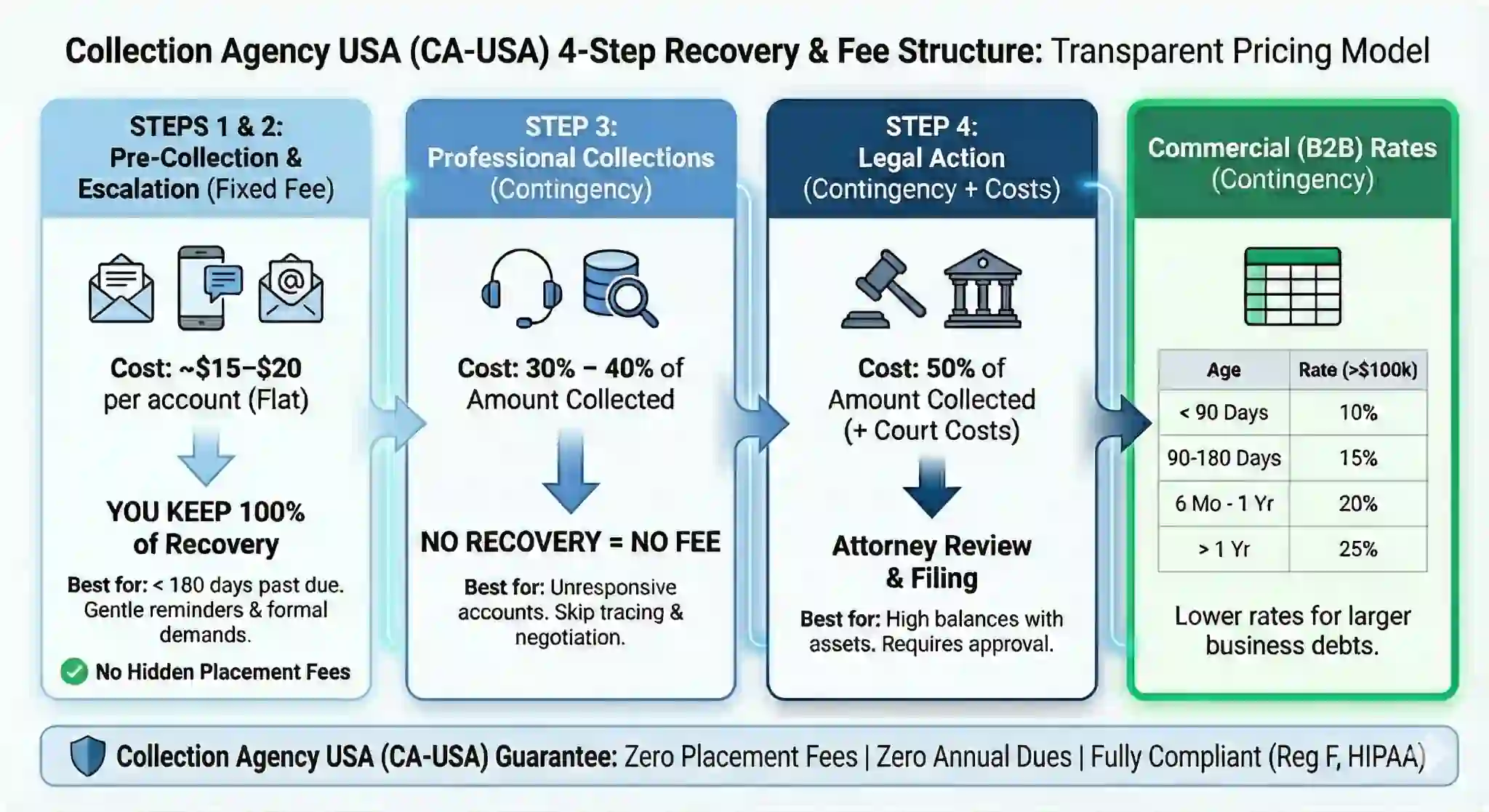
Performance-Driven Pricing:

  • Fixed-Fee: $15 per account (Keep 100% of the recovery).

  • Contingency: 40% (No recovery, no fee).
Frequently Asked Questions: Medical Supply Debt Recovery

Do you handle both B2B and B2C collections?
Yes. We specialize in nationwide recovery for both B2B accounts (hospitals, surgical centers, and private practices) and B2C accounts (individual patients and home-care clients). Whether you are dealing with a bulk invoice or a single patient balance, we have the infrastructure to manage it.

How do you protect our reputation with healthcare providers?
We maintain a 4.85/5-star Google review ranking from over 2,000 professional reviews. This reflects our “Clinical, Not Combative” approach. We resolve disputes through professional mediation and factual evidence, ensuring your professional relationships remain intact while the balance is settled.

Is CA-USA compliant with healthcare privacy standards?
Absolutely. We are fully SOC 2 Type II compliant and adhere to all national debt collection regulations. Our systems are built to handle sensitive medical billing data with the highest level of security and discretion.

Can you find medical directors or facility owners who have “disappeared”?
Yes. Our deep-data skip-tracing tools allow us to locate personal guarantors and business owners even if a practice has closed or moved. We find the responsible parties that standard searches miss.

What is the benefit of your nationwide reach?
Medical supply chains often cross state lines. Because we are licensed and bonded nationwide, we can pursue debtors anywhere in the U.S., providing a single-source solution for your entire accounts receivable portfolio.

How does credit reporting help in this industry?
For B2B accounts, a collection mark on a business credit report can hinder their ability to secure future inventory or financing. This provides significant leverage, often resulting in payment without the need for litigation.


Hire a Collection Agency? Contact us

Protect your margins without sacrificing your professional standing. Partner with CA-USA for medical supply debt recovery that works as hard as you do.

Filed Under: collections

by

Self-Storage Debt Collection: Nationwide Deficiency Recovery

Beyond the Auction: Reclaiming Lost Revenue in the Self-Storage Market
Serving some of the biggest Self-Storage companies in the nation. References Available.

Self-storage collection agency helping storage facility operators recover unpaid rent, past-due tenant balances, and auction deficiencies.

In the self-storage industry, a common myth prevails: “If they don’t pay, I’ll just auction the unit.”  While the “self-help” remedy of a lien sale is a powerful tool for reclaiming physical space, it is rarely a winning financial strategy. With rising operational costs and shifting market dynamics, storage operators cannot afford to settle for pennies on the dollar at auction.

Collection Agency USA (CA-USA) provides a nationwide, clinical-first approach to debt recovery that bridges the gap between a vacated unit and a balanced ledger. We help you recover the deficiency balance—the money still owed after the auction—while acting as a shield for your facility’s professional reputation.


Protecting your reputation, CA-USA performs collections in all 50 states, ensuring a safe approach during every interaction. We provide free litigation screening and bankruptcy scrubs with zero onboarding or annual fees. Our SOC 2 Type II compliant systems ensure total data security, backed by a 4.85/5 rating from over 2,000 professional reviews. Delivering high recovery rates!

Need a Collection Agency? Contact us


Performance-Based Recovery

CA-USA gives two clean lanes:

  • Fixed-Fee: $15 per account (you keep 100% of what’s recovered)

  • Contingency: 40% (no recovery, no fee)

blank


Why Self-Storage Leaders Choose CA-USA

1. “Clinical, Not Combative” Reputation Protection

Storage defaults are often driven by “life happening”—relocations, family transitions, or financial shifts. Aggressive collection tactics from “old school” agencies often result in “review-bombing” and public complaints on Google or Yelp. Our approach focuses on Clinical De-escalation:

  • Neutral Third-Party Status: We lower the “temperature” by removing the personal friction between the tenant and your facility manager.

  • Professional Tone: Our communications are firm but respectful, preserving your brand’s 5-star standing in the community.

  • Recorded Compliance: Every call is recorded and reviewed to ensure 100% adherence to professional standards.

2. Advanced Credit Reporting & Skip Tracing

A “Midnight Move-out” is the bane of the storage industry. CA-USA uses elite skip-tracing databases to locate tenants who have vanished without a forwarding address.

  • The “Credit-Pressure”: We inform tenants that a storage default is a contractual debt. By reporting delinquent accounts to major credit bureaus, we provide a powerful incentive for them to settle the balance before it impacts their ability to rent their next home or secure an auto loan.

3. Solving the Labor Squeeze

Facility managers are increasingly stretched thin. Asking a manager to double as a debt collector is a recipe for burnout and poor customer service. Our automated, clinical outreach handles the heavy lifting, allowing your team to focus on leasing units and facility maintenance.


Recent Recovery Results

  • Multi-State Portfolio (Midwest):
    A storage group with 15 locations was seeing a 40% loss on “deficiency balances” post-auction. Within 90 days of implementing CA-USA’s Fixed-Fee model, they recovered $42,000 in previous “dead-end” accounts without a single negative public review.

  • Independent Facility (Texas):
    After a tenant abandoned a large commercial unit, the auction left a $3,500 shortfall. Using advanced skip-tracing, CA-USA located the tenant’s new place of business and negotiated a full settlement within 30 days.


State-Specific Self-Storage Lien Compliance & Legal Authority

Recovering post-auction deficiency balances requires strict adherence to state-specific Self-Storage Facility Lien Acts. A facility’s legal right to collect unpaid balances hinges on whether the initial lien sale met statutory notice periods, verified delivery rules (certified mail or verified electronic delivery), advertisement windows, and commercially reasonable auction standards:

  • California: Operations must satisfy the California Self-Service Storage Facility Act (Cal. Bus. & Prof. Code § 21700 et seq.), including 14-day preliminary lien notices and formal notice of lien sale prior to public auction.

  • Texas: Governed by Texas Property Code Chapter 59, requiring verified notice of claim, strict payment cure windows, and compliant public advertisement before auctioning property.

  • Florida: Enforced under the Florida Self-Storage Facility Act (Fla. Stat. § 83.801–83.809), mandating written notice via verified mail/email and proper publication before pursuing remaining deficiency balances.

  • Nationwide (All 50 States): Once the statutory lien sale is properly executed and auction proceeds are applied to the ledger, the remaining unpaid rent, late fees, and processing costs constitute a valid, legally enforceable contractual debt. CA-USA audits each file to verify that statutory lien protocols were satisfied before initiating collection and credit bureau reporting.


Our Strategic Recovery Suite

blank

Service Strategic Application Financial Benefit
$15 Fixed-Fee Early-stage delinquency (30–60 days). Keep 100% of the recovered funds; often tax-deductible.
Contingency (40%) Post-auction or “Midnight Move-outs.” No recovery, no fee. Includes high-intensity skip tracing.
Credit Reporting Unresponsive debtors. High-impact leverage to motivate payment.
Litigation Scrubs High-balance units. Identify “judgment proof” tenants before incurring legal costs.

Frequently Asked Questions

If a storage unit is auctioned for less than the tenant owes, what happens to the remaining balance?

An auction does not necessarily wipe out the entire debt. If the sale proceeds are less than the valid rent, fees, and other charges owed, a deficiency balance may remain. Whether that balance can be pursued depends on the rental agreement and applicable state law. Storage operators should apply the auction proceeds correctly and maintain a clear final ledger before referring any remaining balance for collection.

Should a self-storage account be sent to collections before or after the lien auction?

It can depend on the account and the facility’s collection process. Early collection efforts may help resolve a delinquency before an auction becomes necessary, while post-auction collections can focus specifically on any remaining deficiency. Operators should make sure collection activity does not conflict with required lien notices, auction procedures, or state-specific timelines.

What documents make a self-storage debt easier to collect?

Strong documentation can make a major difference when a former tenant disputes the balance. Useful records include the signed rental agreement, complete account ledger, payment history, delinquency notices, tenant communications, lien or auction records, auction proceeds, and an itemized calculation of the final amount owed. The cleaner the documentation, the easier it is to explain and substantiate the debt.

Can a tenant still owe money after abandoning or emptying a storage unit?

Potentially, yes. Simply removing the contents or abandoning the unit does not automatically cancel amounts already owed under the rental agreement. The final balance may include unpaid rent and other properly authorized charges through the applicable termination date. Any deposits, credits, recovered funds, or other adjustments should be applied before the account is referred for collection.

Can late fees, clean-out charges, and auction expenses be included in a collection balance?

Only charges that are properly authorized should be included. Storage operators should review the rental agreement and applicable state law before adding late fees, lien-sale expenses, clean-out costs, administrative charges, or similar items to the amount sent for collection. An itemized balance is generally much easier to support than a single unexplained total.

What if the storage unit was rented by a business instead of an individual?

Business storage accounts can require a different collection approach. The rental agreement should identify the legal business responsible for the unit and whether an owner or another individual provided a personal guarantee. Before placing the account, operators should verify the business name, billing records, contract, guarantor information, and final balance so collection efforts are directed toward the correct responsible party.


Hire a Collection Agency? Contact us

Filed Under: collections

by

CPA-Friendly Collection Agency for Accounting Firms & Their Clients

CPAs Don’t Need Another Vendor — You Need a Recovery Partner That Protects Your Client Relationships

You already do the hard part: keeping books clean, cash flow predictable, and your clients financially organized.

But when receivables age, reporting alone cannot turn an unpaid invoice into working capital. CA-USA helps CPAs and their clients recover overdue accounts professionally, preserve valuable customer relationships, and reduce the burden of internal follow-up.

This version is stronger because it immediately tells search engines and AI systems exactly what CA-USA does for CPAs: recover overdue accounts, protect relationships, reduce AR workload.

CA-USA CPA-friendly accounts receivable recovery helping accounting firms and their clients recover aging invoices through fixed-fee and contingency collections while protecting business relationships.

Protecting your CPA office reputation, CA-USA performs collections in all 50 states, ensuring a safe approach during every interaction. We provide free litigation and bankruptcy scrubs with zero onboarding or annual fees. Our SOC 2 Type II compliant systems ensure total data security, backed by a 4.85/5 rating from over 2,000 professional reviews. Delivering high recovery rates and a reliable client servicing team!

Need a CPA Collection Agency? Contact us


Built for CPAs: Firm on Results, Fair on People

CA-USA is an Account Reconciliation Team, not a “pressure-first” collections shop. Our job is to resolve outstanding accounts in a way that protects brand reputation, preserves relationships, and helps your clients stabilize cash flow without internal chaos.

We currently support 200+ CPAs nationwide—because accountants need a partner who understands how sensitive client relationships are. When a CPA refers a recovery provider, it reflects on the firm. We treat that trust like an asset.

Why CPA Firms Refer CA-USA (And Keep Referring)

When your client has aging AR, they usually face one of two choices:

1) Keep chasing internally (burning employee time, adding stress, producing inconsistent results)
2) Escalate too aggressively (damaging customer relationships and creating reputation risk)

CA-USA is the middle path done correctly: professional mediation + structured pressure + clean documentation.

You don’t want drama. You want closure.

Performance-Based Recovery

CA-USA gives two clean lanes:

  • Fixed-Fee: $15 per account (you keep 100% of what’s recovered)

  • Contingency: 40% (no recovery, no fee)

blank

How We Protect Your Client’s Brand (And Your Reputation)

Most accounts resolve without court involvement. That’s intentional.

We prioritize relationship preservation using cooperative mediation:

  • Calm outreach

  • Clear documentation

  • Direct negotiation with decision-makers

  • Structured payment solutions that feel fair and final

The objective isn’t punishment. It’s payment.

Confidentiality & Professional Standards Note: Account placements are handled under strict data security and privacy protocols to protect client records in full alignment with AICPA professional ethics and confidentiality standards.


The CA-USA Workflow (What You Can Tell Clients With Confidence)

1) Contract & Invoice Intelligence
We gather the paperwork that wins disputes: invoices, signed agreements, POs, delivery proof, service records, emails, and payment history. We also verify business identity and contact pathways.

2) Formal Notice + Multi-Channel Launch
A clean demand notice is sent immediately, backed by documentation you provide us. We use multiple channels to avoid “wrong department limbo” and speed up response.

3) Human-to-Human Negotiation
No robo-calls. We reach controllers, CFOs, owners, and AP managers directly. We isolate the real reason for non-payment—dispute, approval delay, cash timing, or vendor dissatisfaction—and convert it into a firm resolution path.

4) Deep-Dive Verification
If an account gets evasive, we apply practical tools: USPS address verification, skip tracing, and bankruptcy screening. We also run a Litigation Scrub to identify high-risk cases early.

5) Credit Reporting + Pre-Legal Escalation
Where permitted, we offer Credit Reporting to Business Credit Bureaus.
This is a powerful non-legal lever that often produces results without ever stepping into court.

6) Final Lever: Legal Escalation (with your permission only)
If the customer refuses to resolve and the file supports it, we can initiate legal action (with your permission) using our nationwide attorney network —followed by judgment enforcement when appropriate.


Accountants Appreciate This: We Reduce “Hidden Costs”

Aging AR is more than a missing payment.
It’s the hidden burn:

  • Staff time spent chasing

  • Owners distracted from sales and service

  • Uncertainty in cash planning

  • Bad debt that keeps growing quietly

When CA-USA takes over the recovery process, your client regains time and control. You regain cleaner forecasting. Everybody wins.

Quality Controls That Prevent Blowback

Collections failures usually come from sloppy behavior. We guard against that.CPA collections

  • Calls are recorded and reviewed for compliance and quality assurance

  • We use structured messaging to avoid reputational harm

  • We keep communications professional and documented

  • We avoid “rogue collector” behavior that causes review-bombing or public escalation

This is exactly why CPA firms stick with us. The risk profile is managed.

CPA-Focused FAQs

Can a CPA refer a client to CA-USA without handing over the client’s entire accounting file?

Yes. CA-USA only needs the information necessary to document and recover the receivable.

Typical records may include invoices, statements, contracts, purchase orders, payment history, delivery records, and relevant correspondence.

If the CPA firm is sharing confidential client information directly, applicable professional confidentiality rules should still be considered.

The collection agency needs evidence of the debt—not unrestricted access to the client’s books.


Our CPA firm is owed professional fees. Can we hold the client’s tax records until they pay us?

CPA firms should be very careful.

Treasury Circular 230 generally requires tax practitioners to return records clients need to meet their federal tax obligations, even when professional fees remain unpaid.

That means an unpaid accounting or tax-preparation invoice should generally be treated as a receivables problem, rather than assuming client tax records can simply be withheld.

CA-USA can pursue the unpaid professional fee separately through professional debt recovery.


Why can suing a former accounting client for unpaid fees create more risk than the invoice itself?

Because a fee lawsuit can sometimes trigger a counterclaim alleging accounting errors, missed deadlines, negligence, or work outside the agreed scope.

Before escalating, review:

  • the engagement letter;
  • scope of services;
  • billing records;
  • emails and correspondence;
  • dispute history; and
  • evidence supporting the final amount.

For relatively fresh accounts, CA-USA’s $15 fixed-fee option can provide third-party escalation without immediately turning a billing dispute into litigation.


The aging report says $74,000 is overdue, but some customers have unapplied credits and partial payments. Should those accounts go to collections yet?

Not until the balances are reconciled.

The amount submitted for collection should reflect:

Invoices − payments − credits − deposits − adjustments = actual amount due

A clean $41,700 receivable is far easier to defend than an unexplained $47,300 aging balance.

For CPAs, this is an important advantage: clean accounting records can significantly strengthen the collection file before CA-USA ever contacts the debtor.


Can CA-USA work with information exported from QuickBooks, Xero, Sage, NetSuite, or other accounting systems?

Yes. CPA firms and their clients can provide account data through spreadsheet or ledger exports together with the supporting documentation needed for collection.

This allows a practical workflow:

A/R aging report → reconcile balances → export accounts → securely place accounts → monitor recovery

The objective is to avoid forcing accounting teams to manually rebuild information they already maintain in their accounting systems.


Which accounts should a CPA recommend for fixed-fee recovery, and which should go to contingency collections?

Think of it as an escalation ladder.

$15 Fixed Fee: Best suited to suitable newer accounts where professional third-party intervention may be enough. The debtor pays the creditor directly, so the creditor keeps 100% of the recovered amount.

40% Contingency: Better suited to older, difficult, nonresponsive, disputed, or harder-to-collect accounts. The fee applies only when money is recovered.

A CPA can therefore help clients segment their aging report:

Fresh account? Escalate gently.
Stalled account? Increase pressure.
Difficult account? Move to full collections.

That is more economical than putting every delinquent account immediately into contingency collections.

Filed Under: collections

by

The Proactive Client Expansion Playbook for Collection Agencies

What’s the worst call a sales rep can get?

It’s not a “no” from a cold prospect. It’s the lukewarm, “Hey… we’ve decided to try another agency for a while.”

It stings. It stings because it was a client you’d already won. It stings because you know that 90% of the time, it was preventable.

In the collections industry, we spend 80% of our time grinding for new logos—the hunt. We spend the other 20% reactively putting out fires for existing clients. This model is broken. Your single most profitable, highest-conversion growth channel is the client list you already have.

The problem is, most agencies don’t have a system for farming this land. They rely on “gut feel” and quarterly check-in calls.

To win in a market where clients are scrutinizing every vendor, you need to move from reactive management to a proactive expansion plan. This isn’t just “upselling”; it’s a defensive strategy that builds a moat around your best clients.

Here is a simple, data-driven playbook to find, score, and grow the hidden revenue in your current book of business.

From Gut Feel to Data: The Client Health Scorecard

You can’t act on what you don’t track. You need a simple, repeatable “Client Health Score” (0–10) for your top 20% of clients. This isn’t a 50-field CRM questionnaire. It’s a 5-minute assessment based on real-world signals.

What signals actually predict growth or churn?

1. Churn Risks (The Red Flags)

These are your leading indicators of a client at risk.

  • Your Champion is Gone: The CFO, Practice Manager, or Controller who chose you has left. You’ve lost your internal advocate.
  • The “Open Marriage” Talk: They start dropping hints like, “We’re running an RFP,” or “We’re testing another agency on a few accounts.”
  • New Software: They just implemented new AR, billing, or practice management software. This is the #1 moment they will look for a new, integrated partner.
  • Portal Friction: They stop logging into your client portal. They’re disengaged.
  • Complaint Escalation: A single complaint is noise. A pattern of complaints, or one that reaches their leadership, is a five-alarm fire.

2. Loyalty Drivers (The Green Flags)

This is why they stay. You need to know this so you can double down on it.

  • Clean Compliance: You are their compliance shield. They have a low complaint rate and trust you to protect their brand (especially in medical/dental).
  • Zero-Headache Service: Your onboarding was easy, your reports are reliable, and their dedicated rep is responsive. You are easy to work with.
  • Measurable ROI: They know, with data, that your recovery rates are strong.
  • The “White-Glove” Tone: They’ve complimented your team’s professionalism and respectful approach with their customers/patients.

3. Expansion Signals (The Hidden “Buying” Signals)

This is where the money is. These are questions and actions that disguise a readiness to expand.

  • The API Question: “Do you guys have an API?” or “Can you integrate with…?” This is a massive buying signal.
  • The M&A Signal: They just acquired a new practice, bought a competitor, or opened new locations.
  • The Benchmark Request: “How do our recovery rates compare to others in our industry?” They are thinking strategically.
  • The “Escalation” Question: “What’s the process for legal or Step-3 escalation?” They’re thinking about the full lifecycle of their debt.

The 3-Tier Playbook: Turn Your Score Into Action

Now that you have a score, you know exactly where to spend your time. This playbook divides your clients into three clear tiers.

Tier 1: The “All-Stars” (Score 7–10)

These are your champions. They are happy, stable, and probably growing. Your goal is to make them more successful and lock in that relationship.

  • The Play: The Proactive Pilot. Don’t just send a “thank you” gift. Use their data.
    • Script: “I noticed your placements from [State/Service Line] are growing. You also mentioned your team is struggling with accounts in the 60-90 day bucket. Let’s run a 30-day pilot where we take on that earlier-age cohort for you. If it doesn’t demonstrably lift recovery and save your team time, we stop. No strings.”
  • The Tool: A one-page ROI report using their own numbers. Show them, in black and white, how much you’ve recovered.
  • The Goal: Book a formal Quarterly Business Review (QBR). This isn’t a check-in. It’s a strategic review where you present benchmarks and a 6-month growth forecast.

Tier 2: The “Steady Accounts” (Score 4–6)

These clients are content. They pay their bills, but they’re not growing. This is the most dangerous category, as they are a prime target for a competitor’s shiny new offer. Your job is to move them from “content” to “engaged.”

  • The Play: The “One-Thing Fix.” Find one small, tangible friction point and solve it. Is their reporting clunky? Does their team need portal training? Fix it. Proactively.
  • The Tool: A mini-case study. Send a one-paragraph email: “FYI, a B2B client just like you was struggling with… We implemented… and recovered 22% more. Just thought you’d find that interesting.”
  • The Goal: Book a 15-minute “Fit Check.”
    • Script: “I’m not trying to sell you anything, but I want to make sure we’re pointed at the right target. Of all your AR right now, which bucket is the biggest headache—is it the age of accounts, the balance of accounts, or just the sheer volume?”

Tier 3: The “At-Risk” (Score 0–3)

This is a retention-or-churn moment. All other priorities drop.

  • The Play: The “No-Risk Challenge.” This is not an email. This is a phone call. You acknowledge the issue head-on.
    • Script: “I know we had a service issue last month, and I want to earn back your trust. Give us 25 accounts your other agency (or your in-house team) couldn’t resolve. Let us run a second-placement test at preferred terms. If we don’t beat their performance, you owe us nothing. Fair?”
  • The Tool: A 14-day action plan. Put it in writing. “Here are the 3 things we are doing to fix this, who owns it, and when it will be done.”
  • The Goal: Escalate internally. Get your operations lead and success manager on a call with the client. Show them you are treating this with the urgency it deserves.

Make It Stick: A Simple System for Cadence and Tracking

This entire system will fail if it’s just a “good idea.” It has to live in your workflow.

  1. Lightweight CRM Fields: Add these 4 fields to your client accounts.
    • Expansion Score (0–10)
    • Top Churn Risk (Pick-list)
    • Next Expansion Bet (Open text)
    • Last QBR Date
  2. Set Your Cadence:
    • Monthly: Refresh the Expansion Score for your top 20 clients. (30 minutes, max).
    • Quarterly: Conduct QBRs with your “All-Stars” and “Steady Accounts.”
    • Event-Based: The moment you hear a champion is leaving or a complaint is escalated, update the score and risks immediately.

The daily hunt for new logos will always be part of sales. But the most predictable, profitable growth comes from the clients who already write you checks.

This system gives you a map. It shows you exactly where to invest your time, where to anticipate risk, and where to press your advantage. It stops you from being a reactive vendor and solidifies your role as a strategic, indispensable partner in your client’s financial health.

Filed Under: collections

by

Texas Collection Agency: 9 Checks Before Hiring

Hiring a collection agency in Texas is not just about comparing contingency rates. Texas has its own rules around third-party debt collection, including the $10,000 surety bond requirement, while B2B and consumer accounts can follow very different compliance paths.

The smarter question is whether the agency can recover effectively without creating legal, data-security, or reputation problems for your business. That means checking bonding, documentation, cybersecurity, collection methods, and net recovery—not just the lowest quoted fee.

checklist for hiring a compliant collection agency in Texas

Need a Compliant Collection Agency? Contact us


Things to check before hiring a collection agency:

1. Confirm They’ve Filed the Mandatory $10,000 Surety Bond

Every third-party debt collector must file a $10,000 “Third-Party Debt Collector Surety Bond” with the Texas Secretary of State before touching a Texas account. Ask for the bond number and verify it online.

2. Check Texas Debt Collection Act (TDCA) Policies

The TDCA (Texas Finance Code §392) bans threats, false lawsuits, and other abusive tactics. Violations are misdemeanors carrying $100–$500 fines per count—plus civil liability.

3. Make Sure They Follow the FDCPA for Consumer Debts

Even if your past-due invoices are business-to-business, many agencies also collect consumer debt. One FDCPA slip can cost up to $1,000 per consumer, plus actual damages and attorney fees.

4. Demand Written Compliance with the Texas Data Privacy & Security Act

Effective July 1 2024, the TDPSA lets the Attorney General fine companies up to $7,500 per violation for mishandling Texans’ personal data. Ensure the agency has encryption, role-based access, and a 30-day cure process.

5. Verify Registration (or Exemption) with the Office of Consumer Credit Commissioner

While the OCCC licenses lenders, many agencies also hold OCCC registrations for related services. An agency that ignores the regulator is a red flag.

6. Review Their Call & Letter Scripts

Look for limited call attempts, no post-card notices, bilingual support, and a no-threat policy. Your brand name will appear in every communication.

7. Inspect Cybersecurity & Portal Controls

Require MFA on client portals, SOC 2 audits, and no unencrypted spreadsheets. A single breach can trigger both TDPSA penalties and surety-bond claims.

8. Compare Net-Back—Not Headline Rates

Calculate dollars-returned-after-fees. A 25 % agency that nets $8,000 beats a 15 % shop that only recovers $4,000.

9. Demand a Transparent Contract

Look for:

  • Indemnification if the agency violates a law

  • No hidden litigation, skip-trace, or credit-report fees

  • Easy termination clause when results lag


What Happens if You Hire a Non-Compliant Agency?

Misstep Governing Law 2025 Penalty Exposure
No $10k bond on file TX Fin. Code §392.101 Bond claim + injunction; collection efforts void
Abusive calls/threats TDCA $100–$500 per violation + misdemeanor record
Harassment/deception FDCPA Up to $1,000 per consumer + damages/fees
Data-privacy breach TDPSA Up to $7,500 per affected record
False credit-reporting FCRA + TDCA Statutory & actual damages; AG enforcement
Unfair practices (B2B) Deceptive Trade Practices Act Up to $20,000 per violation, treble damages for seniors

Add attorney fees, lost customers, and brand damage, and the “cheapest” agency quickly becomes the most expensive.


Why Rock-Bottom Rates Are a Red Flag

  1. No budget for compliance. Licensing, bonding, and SOC 2 audits cost real money.

  2. High-volume mills. Collectors juggle thousands of files; smaller debts get no follow-up.

  3. Hidden add-ons. Low bids often exclude skip-tracing, asset searches, or suit preparation.

  4. Offshore data risks. Cheap labor ≠ TDPSA-grade security.

  5. Higher complaint ratios. Agencies that cut corners draw Texas AG and CFPB scrutiny—dragging your company with them.


Bottom Line

Choose the agency with the strongest compliance track record and highest net-back, not the one with the lowest sticker price. A few minutes of due diligence can shield your Texas business from fines, lawsuits, and reputation blow-ups.

Filed Under: collections

by

What HVAC Businesses Need to Know About Hiring a Collection Agency

HVAC businesses often deal with unpaid service calls, installations, maintenance contracts, emergency repairs, and commercial account balances. When those invoices age, internal follow-up can drain staff time and cash flow without solving the problem.

A specialized HVAC collection agency helps recover those balances professionally while handling common disputes over service quality, warranties, scope of work, and commercial payment delays. The goal is to get paid without unnecessarily damaging customer relationships.

CA-USA HVAC collection agency helping contractors recover unpaid service, installation, maintenance, and commercial HVAC invoices through professional fixed-fee and contingency debt recovery.

Protecting your HVAC business reputation, CA-USA performs collections in all 50 states, ensuring a safe approach during every interaction. We provide free litigation and bankruptcy scrubs with zero onboarding or annual fees. Our SOC 2 Type II compliant systems ensure total data security, backed by a 4.85/5 rating from over 2,000 professional reviews. Delivering high recovery rates and a reliable client servicing team!

Need a Good Collection Agency? Contact us


Choosing the right agency is critical. Here’s your roadmap to navigating the process:

1. Know What You Need

Before diving into the search, take stock of your situation:

  • Analyze Your Accounts: Are your outstanding invoices mostly from residential clients or commercial contracts? HVAC businesses often deal with disputes like missed appointments or service dissatisfaction. For instance, a residential customer might refuse payment, claiming their unit still isn’t cooling properly. Commercial clients may delay payments due to internal budgeting processes. The type of account will influence the best recovery strategy.
  • Assess the Volume: Do you have a constant stream of delinquent accounts due to seasonal surges, or just a few tough cases? If summer installations often result in overdue invoices, you may need an agency familiar with handling seasonal fluctuations.

2. Find Your Perfect Match

Not all collection agencies are created equal. Look for these key qualities:

  • HVAC Industry Experience: Agencies with HVAC experience understand disputes like warranty claims and service quality disagreements. For example, they’ll know how to handle a customer claiming their system didn’t perform as expected during the warranty period.
  • Local Expertise: An agency familiar with your state or region will understand local regulations and consumer behavior. If you’re operating in a hot climate, for instance, they’ll know how to navigate complaints about system performance in extreme heat.
  • Tech Savvy: Modern collection agencies offer online portals for easy account monitoring, integrate with your invoicing software, and use advanced skip tracing tools to locate hard-to-find customers.

3. Compliance is Key

Debt collection is a regulated field, and staying compliant protects your business:

  • FDCPA Compliance: Ensure the agency adheres to the Fair Debt Collection Practices Act to avoid harassment complaints.
  • State-Specific Laws: States often have stricter rules. For example, some states may limit the interest you can charge on overdue payments.
  • Licensing: Verify that the agency is licensed to operate in all states where your customers reside.

4. Transparency and Fees – No Hidden Surprises

Discuss fees and contracts upfront to avoid surprises:

  • Fee Structures: Decide between a contingency fee (a percentage of recovered debts) or a fixed fee. For example, a contingency fee might make sense for an older $10,000 commercial account, while a fixed fee could be cost-effective for smaller, recent accounts.
  • “No Recovery, No Fee” Options: This minimizes your risk, especially if you’re uncertain about the recoverability of some debts.
  • Hidden Costs: Read the fine print to ensure there are no administrative or late-recovery charges.

5. Protecting Your Reputation

A collection agency becomes an extension of your business, so they must align with your values:

  • Professionalism: HVAC businesses rely on repeat customers and referrals. For instance, a respectful approach to resolving disputes, like working with a customer to verify service records, protects your reputation.
  • Dispute Resolution: Ensure the agency has a clear process for handling disputes. For example, if a commercial client disputes the scope of a maintenance contract, the agency should work to resolve it amicably without damaging your relationship.

6. Due Diligence is Your Best Friend

Before signing on with an agency, do your homework:

  • Check Reviews: Read testimonials from other HVAC businesses to gauge success rates and professionalism.
  • Request References: Reach out to similar companies that have worked with the agency to understand their experience.
  • Scrutinize the Contract: Look for terms on termination, confidentiality, and data ownership. For example, ensure that customer information will not be shared or sold.

7. Timing is Everything

Timing plays a big role in debt recovery success:

  • Early Intervention: Engage an agency when accounts are 90–120 days overdue for higher recovery rates. For example, a missed payment on a large commercial HVAC installation is more likely recoverable if acted on early.
  • Internal Efforts First: Before outsourcing, try friendly reminder calls, emails, or physical letters. A simple follow-up call about a residential maintenance invoice can often resolve issues before they escalate.

8. Have a Backup Plan

Be prepared for unexpected scenarios:

  • Dispute Resolution: Establish a clear process for handling customers who dispute charges. For example, a customer might claim your technicians didn’t complete a repair. Ensure the agency knows how to handle these claims tactfully.
  • Exclusions: Define accounts you don’t want pursued, such as those involved in legal disputes over the quality of service or warranty terms.

Hire Collection Agency

Examples of Successful HVAC Debt Recovery

  1. Residential Accounts: A homeowner delays payment, claiming the system wasn’t installed properly. The agency works with your service records to confirm the installation was within specifications, resolving the dispute.
  2. Commercial Accounts: A small business delays payment for HVAC maintenance, citing cash flow issues. The agency negotiates a partial payment plan, recovering 80% of the debt within a month.
  3. Seasonal Surge Accounts: After a hot summer, many customers fail to pay for emergency repairs. The agency uses tailored follow-ups to recover over 60% of overdue accounts within three months.

By following these guidelines and choosing the right agency, HVAC businesses can recover outstanding invoices effectively while protecting their reputation and customer relationships. Remember, a good collection agency isn’t just about collecting money—they’re a partner in safeguarding your revenue and ensuring your business thrives.

Filed Under: collections

  • Page 1
  • Page 2
  • Page 3
  • Interim pages omitted …
  • Page 8
  • Go to Next Page »

Primary Sidebar

blank

Unpaid Bills? Contact Us

    Please prove you are human by selecting the heart.


    Email : support@CollectionAgencyUsa.com
    Ph: 1-844-666-7890

    Recent Posts

    • Collection Agency for Medical Supply & DME Firms: Reputation Safe
    • Self-Storage Debt Collection: Nationwide Deficiency Recovery
    • CPA-Friendly Collection Agency for Accounting Firms & Their Clients
    • The Proactive Client Expansion Playbook for Collection Agencies
    • Texas Collection Agency: 9 Checks Before Hiring
    • What HVAC Businesses Need to Know About Hiring a Collection Agency
    • Is It Ethical for Medical Practices to Hire a Collection Agency
    • Indiana Debt Collection Agency: 6 Details That Can Change a Recovery
    • 20 Essential Tips for Doctors Hiring a Medical Office Administrator
    • Hiring a Collection Agency vs. Recovering Debt Yourself: Which is the Better Choice?
    • Expert Guide to Finding the Perfect Collection Agency
    • How a Collections Agency Drives Results: A Case Study
    • Hire a Local Collection Agency in Ohio: Reputation Safe
    • Collection Agency You Can Trust: 4.9/5 Customer Rating
    • Illinois Commercial and Consumer Collection Agency: Reputation Safe

    Featured Posts

    • Illinois Commercial and Consumer Collection Agency: Reputation Safe
    • Why is it Worth Investing in Collection Services?
    • Commercial Collection FAQs Nobody Usually Answers
    • What Medical Practices Should Expect From a Collection Agency

    COPYRIGHT: BIOTECHARTICLES | 2026 | This content is provided for general informational purposes only and should not be considered legal advice. Collection laws and requirements may vary by state, account type, documentation, debtor status, and specific facts. Please consult qualified legal counsel for guidance regarding your particular situation. CA-USA and its authorized collection partners service accounts in accordance with applicable federal and state collection requirements. Visit our home page to know more about us.