• Skip to main content
  • Skip to primary sidebar

Collection Agency

  • Home
  • Cost
  • Contact Us for Collections

collections

by

Small Business Collection Agency: Reputation Safe & Recovery at $20 per Account

Small businesses shouldn’t have to choose between chasing unpaid invoices and running their business. CA-USA helps small businesses recover both consumer and commercial debt with two flexible collection options: low-cost Fixed Fee Collections and traditional Contingency Fee Collections. Fully licensed nationwide, CA-USA combines professional debt recovery with an approach designed to protect cash flow, customer relationships, and your time.

For businesses with multiple overdue accounts, the Fixed Fee option can significantly reduce collection costs, while contingency collections provide a no-recovery, no-fee alternative for tougher accounts. Fixed collection fees of $20 per account usually qualifies as a deductible business expense (making this a free service), giving small businesses another practical way to control recovery costs.

CA-USA small business collection agency offering fixed-fee and contingency debt recovery for unpaid consumer and commercial accounts nationwide.


Protecting your office reputation, CA-USA performs collections in all 50 states, ensuring a safe approach during every interaction. We provide free litigation and bankruptcy scrubs with zero onboarding or annual fees. Our SOC 2 Type II compliant systems ensure total data security, backed by a 4.85/5 rating from over 2,000 professional reviews. Delivering high recovery rates!

Need a Small Business Collection Agency? Contact us


Small businesses can manage their accounts effortlessly through CA-USA’s easy-to-use, secure client portal. This portal is accessible 24×7, allowing clients to submit, update, and track the status of their accounts at their convenience. CA-USA’s no hidden fee policy further reinforces its commitment to transparency, ensuring clients are always aware of their financial commitments. For those opting for Contingency Collections, our policy of “no recovery, no fee” offers peace of mind, aligning the agency’s success with that of its clients.

Serving thousands of small businesses nationwide, CA-USA emerges as a reliable and effective partner in debt collection, tailored to the needs of modern businesses.

Need a Collection Agency?    Get in Touch with us:


    Please prove you are human by selecting the heart.

    Unique Features of CA-USA

    • Free Bankruptcy screening.
    • Free Credit Bureau reporting in contingency collections.
    • Free Change of Address check and Litigious defaulter check.
    • Accounts can be further recommended to one of our national network of lawyers for filing a Legal suit to recover money.
    • We can perform debt collections in both English and Spanish.
    • Apart from B2C collections, we also have a dedicated Commercial Division for B2B collections.
    • Serving Nationwide ( Licensed in all 50 states and Puerto Rico).
    • CA-USA has consistently passed SSAE 18 SOC 1 Type 2 data security compliance. We are also FDCPA, GLBA and HIPAA Compliant.

    Collection Cost:
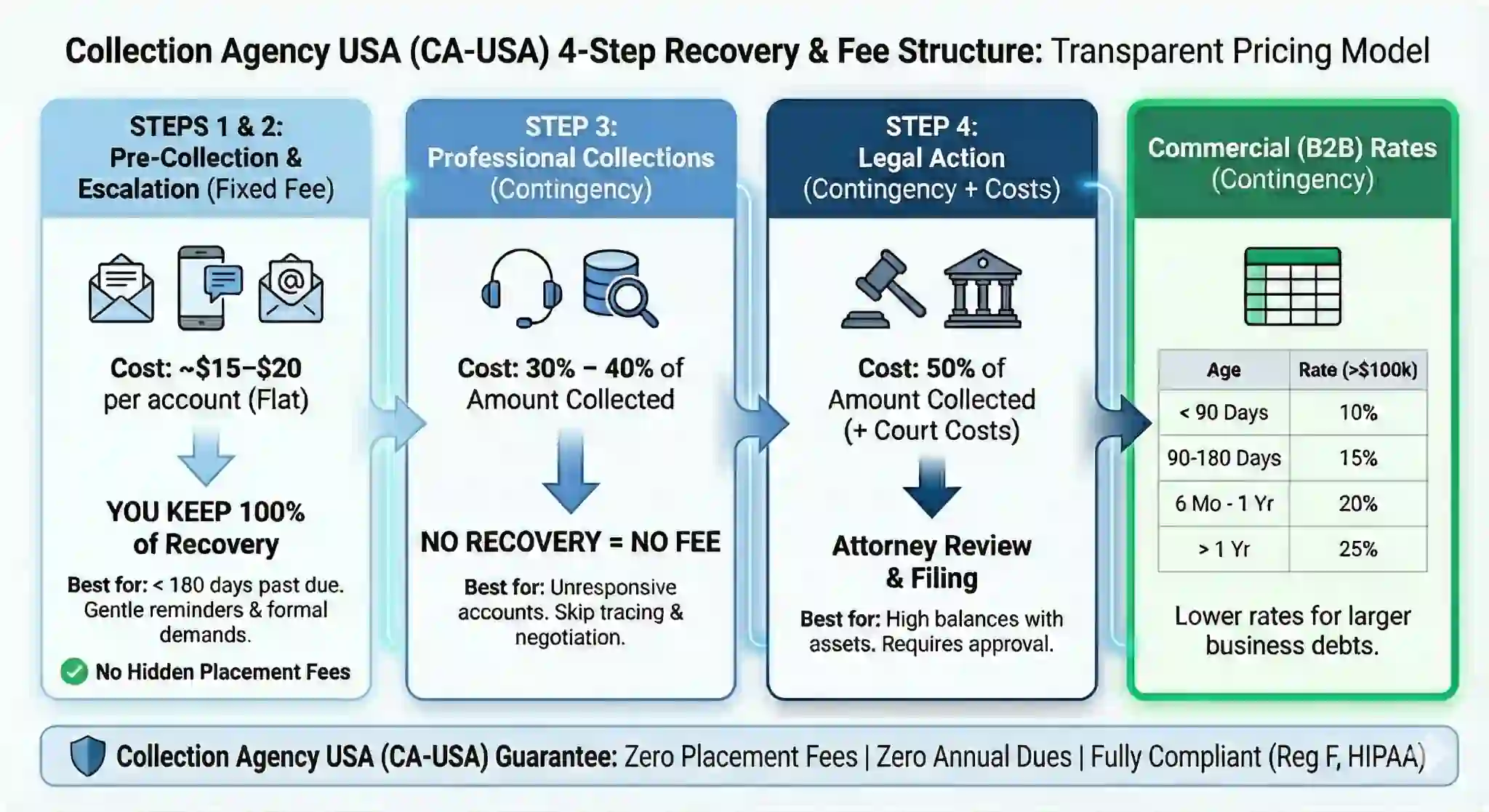
    • Fixed-fee collections: $15-$20 per account, and the debtor pays you directly—you keep 100% of the recovery.
    • Contingency collections: Ideal for older accounts, with a 40% fee only on amounts recovered.

    Read online reviews from some of our clients, even debtors from whom we collect

    “CA-USA is a great partner for our trades company. They worked hard to design a plan that meets our needs and are very good at helping us meet our goals with regards to outstanding AR. Highly recommend their services to any business.”

    “CA-USA has been absolutely a pleasure to deal business with. They helped the small business that I work for get an amazing price. Also I would like to mention the prompts replies to any questions or concerns that I had. Thank you so much VITO! You and your team are amazing.”

    “I had such a great experience with the collector over the phone. They were honest, upfront, very polite, very helpful & informative. They made sure to work with me & confirm that everything was understood on my end. Explain everything with detail and was able to answer all my questions.”

    “Client services at CA-USA has always provided excellent support. Today speaking with Cassandra in the Client Services department was no exception. She was able to switch account information that I needed done quickly while I was on the phone with her. Very professional and ‘listened’ to help me get the resolution needed. Thank you Cassandra!!”

    “Rick has been pleasant & helpful every time I’ve needed to speak with him. Paying bills is part of life & sometimes we fall behind. It’s nice to do business with folks that are respectful & understanding. Thank you :)”

    “Granted it’s a collection agency (my fault it got that far) BUT they are sooo nice! If I have an issue I can call and they help or if it’s just a general question. Always friendly and they don’t handle it like it’s just business, more caring!”


    FAQs

    If I already wrote off an unpaid invoice as bad debt, can CA-USA still collect it?

    Yes. An accounting or tax write-off does not automatically erase the customer’s obligation. If you previously deducted a business bad debt and later recover money, the IRS says some or all of that recovery may need to be reported as income. Check the tax treatment with your accountant.

    Do I need a signed contract before sending a small-business account to collections?

    Not always. A signed contract is excellent documentation, but invoices, purchase orders, emails, delivery records, statements, signed estimates, and prior payments may also help substantiate an account. For sales of goods, the UCC recognizes that agreements can sometimes be established through conduct or written confirmations, although specific transactions may require a writing.

    If my customer is a sole proprietor or DBA, is the debt consumer or commercial?

    The purpose of the debt matters more than the business structure. A debt incurred primarily for business purposes is generally considered commercial for federal FDCPA purposes, even when the debtor operates as a sole proprietor. Personal, family, and household debts are treated differently, and state rules may add additional requirements.

    Can I send only the undisputed invoices to collections?

    Yes. If a customer disputes one invoice but owes several others, you can separate the accounts and place only the clearly documented, undisputed balance. This often creates a cleaner collection file and prevents one disagreement from delaying recovery of every invoice.

    Should a small business use fixed-fee or contingency collections?

    For newer accounts, CA-USA’s $15 fixed-fee service can be economical because the debtor pays you directly and you keep the recovery. Older or more difficult accounts may be better suited to 40% contingency collections, where there is no collection fee unless money is recovered.

    Is sending an account to collections the same as selling the debt?

    No. When you place an account with a collection agency, the agency generally pursues payment on your behalf while you remain the creditor. Selling debt is different: ownership of the account is transferred to a debt buyer, who then attempts to collect for itself. The CFPB specifically distinguishes collection agencies from companies that purchase delinquent debts.

    Filed Under: collections

    by

    Commercial Collection Agency: Google Rating of 4.85 / 5 stars

    At Collection Agency USA (CA-USA), commercial debt recovery is our core business, not a side service. For over 20 years, we’ve helped companies across the country turn past-due B2B invoices back into working capital while staying fully compliant with state and federal collection laws.

    • 20+ years focused on commercial/B2B collections

    • Thousands of clients served nationwide through our secure online portal.  We recover what you’re owed while preserving valuable business relationships.

    • Recovery rates above 80% on viable commercial debts when placed early

    • 10%–40% contingency fees, depending on balance, age, and complexity of the account

    • No recovery, no fee on contingency placements

    • Backed by an A+ BBB rating and strong Google reviews, plus robust insurance coverage for your peace of mind

    CA-USA commercial B2B debt recovery services helping businesses recover past-due invoices, improve cash flow, and manage high-value commercial accounts nationwide

    From pre-collection outreach to full litigation, we tailor our strategy to each claim and each debtor. Our commercial collectors know how to handle high-value claims and complex negotiations, coordinate with a nationwide attorney network when legal action is needed, and keep you updated at every step—so you see clear progress instead of wondering what’s happening with your money.

    Highly rated on Google reviews, CA-USA is your trusted partner in commercial debt collection. References available upon request.

    • Licensed. Bonded and Compliant
    • 24/7 Secure Online Portal
    • Bilingual
    • No on-boarding fee

    Need a Commercial Collection Agency?


      Please prove you are human by selecting the cup.

      Our Interests are Aligned

      We are fully committed to collecting the debt because we only get paid if you do. We both benefit solely from the successful recovery of your invoices. Otherwise, all the resources and effort we invest in debt recovery will be wasted, and we will incur that loss entirely as we operate on a No Recovery, No Fee basis.

      Commercial Collection Fee:

      Unlike consumer debt, commercial collection cost varies based on three factors:

      1. Amount Due: Higher the balance, lower the fee.
      2. Age of account: Accounts older than 1 year attract higher fee.
      3. Complexity of the case: Complex cases, or those with less than ideal backup documentation draw higher fee.

      Fee varies from 10% to 40% of the amount assigned.

      Commercial collection cost

      Commercial Collections Process

      1. Placement of Debt: A business transfers the debt of a non-paying client to a collections agency, along with all backup documents, along with any emails in which debtor has accepted that they need to pay the amount assigned.
      2. Verification and Scrutiny: The agency verifies the debt and assesses the debtor’s ability to pay. Understand the details of the debt, including the amount, terms, and history.
      3. Initial Communication: The agency contacts the debtor, often through letters or calls or emails, to inform them about the debt and negotiate payment. Skip tracing is done if needed.
      4. Background investigation: The agency will conduct an investigation into the debtor and the business proprietors to assess the business’s functionality and financial success, which will guide the negotiation process.
      5. Persistent Efforts and Negotiation: If initial attempts fail, the agency persists with follow-ups, negotiating payment plans or settlements if necessary. If the debtor can’t pay in full, the agency will negotiate a partial payment plan or settlement.
      6. Final Chance before Firm Tactics Kick in: The pre-collections team will give the debtor one final opportunity to settle their account before it is considered for legal action. This may be their last chance to resolve the matter without going to court.
      7. Business Credit Reporting: When a commercial collection agency is involved in recovering debts, it can affect the business’s credit standing, potentially jeopardizing its ability to secure future loans. Impacting a defaulter’s business credit history is an effective collection strategy, often leading to the immediate settlement of accounts.
      8. Legal Action: As a final resort, legal proceedings may be initiated to recover the debt.
        A lawyer will:

        • Initiation: Prepare legal documents, including demand letters and settlement agreements.
        • Litigation: If necessary, initiating legal proceedings to recover debts and representing the agency in court.
        • Enforcing Judgments: Assisting in enforcing court judgments against debtors, such as garnishments or liens.
      9. Resolution: Upon successful collection, the agency takes a fee, and the remaining amount is returned to the business.

      CA-USA seven-step commercial B2B debt recovery framework showing account review, skip tracing, outreach, negotiation, commercial credit escalation, compliance review, and legal forwarding.


      Read reviews from some of our clients

      “We have been using CA-USA for about 2 years. They are wonderful to work with. Todd our account manager is always very helpful and answers our questions promptly. I highly recommend them for all collection services!” 


      “I have worked with CA-USA for the last 3 years. As the Director of RCM for a large medical company, I could not be happier with their performance as a collection agency, but also their approach to handling our mutual clients. Bruce, and Paul have not only exceeded expectations, but have helped us foster good will with our clients as well. If I could give them 10 stars I would.” 


      FAQs

      Our customer still buys from us but has old unpaid invoices. Can we send only the old balance to collections?

      Yes. You do not necessarily have to terminate the entire business relationship. Clearly separate the delinquent invoices from new transactions and consider tighter terms—such as deposits, COD, or shorter payment terms—on future orders. CA-USA can pursue the older balance professionally while you decide whether the customer relationship is still worth preserving.

      blankThe company owes us money, but the owner says, “It’s an LLC—you can’t collect from me personally.” Is that true?

      Often, the LLC itself is the debtor. An owner is generally not personally liable merely because they own or manage the LLC. However, a signed personal guarantee or other legally enforceable obligation can materially change the situation. Always provide CA-USA with guarantees, credit applications, contracts, and amendments when placing the account.

      What if the debtor suddenly claims our product or service was defective only after collections begin?

      A late dispute does not automatically make an invoice disappear, but it does need to be addressed. Provide the collection agency with purchase orders, signed contracts, delivery confirmations, emails accepting the work, earlier complaints, credits, and payment history. Strong contemporaneous documentation helps distinguish a genuine commercial dispute from a payment-delay tactic.

      What happens if a business files bankruptcy after we send the account to collections?

      Normal collection activity generally must stop once the bankruptcy automatic stay applies. The account then moves into the bankruptcy process, where the creditor may need to monitor notices and file a Proof of Claim with supporting invoices or contracts when required. CA-USA’s bankruptcy screening can help identify these situations early.

      Can an unpaid commercial account affect the debtor company’s business credit?

      Potentially, yes. Business credit reports can contain collection filings along with bankruptcies, liens, judgments, UCC filings, and other payment-risk information. This is why properly handled commercial credit reporting can create meaningful leverage with an operating business that depends on suppliers, financing, or trade credit.

      What if the debtor shuts down “ABC LLC” and suddenly starts operating as “ABC Solutions LLC”?

      A new name does not automatically make the new company responsible for the old company’s debt—but it is worth investigating. CA-USA can help identify addresses, principals, business activity, and related entities. If assets were transferred or another entity may have legal responsibility, the facts and documentation should be reviewed before deciding whether attorney involvement is appropriate.

      Filed Under: collections

      by

      Dental Bill Collection Agency: Serving Nationwide: HIPAA Compliant

      Startling statistics of unpaid dental bills

      • It is estimated that the total outstanding dental debt in the USA to be around $100 billion.
      • On average, it takes dental practices about 18 days to collect payment on their bills.
      • Average write-off is 7% , means dental practices lose about 7% of their revenue due to unpaid bills. Lets calculate – If a practice operates on a 25% profit margin, a 7% write-off means that 28% of their profit is gone.
      • Practices that provide more expensive services, such as cosmetic dentistry or orthodontics, have a higher percentage of unpaid bills.

      10 out of 10 dentists recommend us. CA-USA specializes in collecting dental debts, we have been consistently delivering high recovery rates using our cost effective debt collection services.

      CA-USA dental collection agency helping dentists, orthodontists, and dental practices recover unpaid patient balances with patient-friendly, HIPAA-conscious collection services.

      • Nationwide coverage across all 50 states and Puerto Rico, so accounts can continue to be handled even if a debtor relocates.
      • HIPAA- and FDCPA-compliant processes, supported by secure handling of sensitive medical, personal, and financial information.
      • 4.85-star rating from more than 2,000 reviews, reflecting strong client and consumer feedback.
      • Patient-friendly, reputation-conscious collections. We pursue valid balances professionally while protecting the provider-patient relationship.
      • A dedicated account representative with full team support, giving you a consistent point of contact instead of being routed through a generic call-center queue.

      CA-USA’s Methodology for Dental Debt Recovery

      • Protect your reputation.
      • Follow all Federal and Local debt collection laws.
      • Free address check, skip tracing, bankruptcy check and litigious defaulter check.
      • Licensed to collect in all 50 states and Puerto Rico. Even if your patient crosses state lines, we can handle it.
      • We treat your patients with dignity and respect when recovering your unpaid invoices.
      • We consistently deliver high recovery rates and far exceed the industry average.
      • If you want, we can report unpaid debts to credit bureaus at no charge.
      • Over 2000 Google reviews averaging 4.85 out of 5, and 90% of reviews are from people we’ve collected money.


      Need a Collection Agency?    Get in Touch with us:


        Please prove you are human by selecting the star.

        Collection Cost:

        • Fixed-fee collections: $15 per account, and the debtor pays you directly—you keep 100% of the recovery.
        • Contingency collections: Ideal for older accounts, with a 40% fee only on amounts recovered.

        blank


        Frequently Asked Questions

        Should I send a patient to collections while their dental insurance appeal is still pending?

        First confirm the patient’s final responsibility. If an insurance appeal or adjustment could change the balance, reconcile the account before collection. Once the correct patient amount is documented, the account can be considered for placement.

        Can an unfinished crown, implant, orthodontic case, or other incomplete treatment be sent to collections?

        Potentially, but the dental office should not automatically assign the original treatment-plan total. Determine which services were completed, insurance payments received, patient payments made, and any credits due. Only the supported final balance should be placed for collection.

        How much patient information should a dental office send to its collection agency under HIPAA?

        Provide only the information reasonably necessary to identify the patient and substantiate the debt. Typical records include responsible-party details, dates of service, balances, payment history, insurance adjustments, and relevant billing documentation. Avoid sending unnecessary clinical information.

        What if dental insurance paid the patient directly instead of paying our office?

        Document the claim, EOB, insurance payment, patient financial agreement, and remaining balance. Depending on the agreement and applicable state rules, the patient may still be responsible for paying the dentist even when insurance benefits were sent directly to the patient.

        Can a missed-appointment or late-cancellation fee be sent to collections?

        Only when the fee is properly supported. The practice should confirm that its cancellation policy was clearly disclosed or acknowledged by the patient and that the charge is permitted under applicable law before including it in a collection balance.

        Why should a dentist read reviews written by patients who were actually contacted by the collection agency?

        Client reviews show how an agency serves dental practices, while patient or debtor reviews reveal how collectors actually communicate. Look for patterns involving courtesy, dispute handling, payment arrangements, and responsiveness because the agency’s behavior can directly affect your dental practice’s reputation.


        Online reviews left by Doctors

        “We have been using them for about 2 years. They are wonderful to work with. Todd our account manager is always very helpful and answers our questions promptly. I highly recommend them for all collection services!” 


        “I have worked with CA-USA for the last 3 years. As the Director of RCM for a large medical company, I could not be happier with their performance as a collection agency, but also their approach to handling our mutual clients. Vince, Bruce, and Paul have not only exceeded expectations, but have helped us foster good will with our clients as well. If I could give them 10 stars I would.” 

        Reviews left by Patients/Debtors

        The “collector” who helped me with my medical bill payments was awesome. She was kind, understanding and did not pressure me at all. I have a very high amount of medical bills that I am trying to pay off and CA-USA is a company that should teach all debt collectors the fine art of respect and dignity.


        The collector was very courteous, and made submitting the payment effortless. I am glad that I was made aware of a debt that I had forgotten about, and was able to settle. It was a pleasant surprise to deal with such a patient and pleasant individual compared to the usual rude and threatening types usually encountered with collection agencies.


        Paying off a debt collector is never a fun thing to do. However, the collector that handled my case was so nice and very patient with me. My account was flagged for fraud and the last transaction wouldn’t go through. The collector was very understanding and allowed me to get it situated. She gave me her direct line number, when I sorted everything out I just called her back! She was super friendly, given the circumstances. I hope everyone has a debt collector like her!!!


        Reasons behind mounting unpaid dental bills

        Unpaid dental bills and dental debt are significant issues in the United States, reflecting broader challenges in the healthcare system. Here’s some background on the situation:

        1. High Cost of Dental Care: Dental procedures can be expensive, often not fully covered by insurance. Many Americans either lack dental insurance or have plans with limited coverage. This can lead to large out-of-pocket expenses for procedures like root canals, crowns, braces, and more.
        2. Impact of Dental Debt: For individuals and families, especially those with lower incomes, these costs can lead to significant debt. Dental debt can affect credit scores, leading to broader financial difficulties. It also often results in people delaying or avoiding necessary dental care, which can worsen their oral health and lead to more expensive treatments later.
        3. Insurance Coverage Gaps: Dental insurance in the U.S. is not as comprehensive as medical insurance. Many dental insurance plans have low annual limits, high deductibles, and don’t cover certain procedures. Medicare, the federal health insurance program for seniors, does not typically cover dental care, impacting older adults.
        4. Access to Care Issues: High costs and lack of insurance can lead to disparities in access to dental care. This affects not only individuals’ oral health but also their overall health, as poor oral health is linked to conditions like heart disease and diabetes.
        5. COVID-19 Impact: The COVID-19 pandemic exacerbated these issues, as many people lost jobs and associated health benefits, including dental insurance. Additionally, many dental offices were closed for routine care during parts of the pandemic, leading to delayed treatments and increased costs.
        6. Government and Nonprofit Interventions: There have been efforts by government programs and nonprofit organizations to provide affordable dental care, but these do not fully address the broad scale of the problem.
        7. Debt Collection Practices: The practices of debt collection for unpaid dental bills can also be an issue, with some patients facing aggressive collection tactics.
        8. Dental Health and Socioeconomic Status: There is a strong correlation between dental health and socioeconomic status. Those with lower incomes are more likely to suffer from dental health issues and the consequent financial burdens.
        9. Long-Term Consequences: Unaddressed dental issues can lead to more serious health problems, creating a cycle of health and financial difficulties.
        10. Policy Debates: The issue of dental care affordability and access is part of larger debates about healthcare policy in the U.S., including discussions about expanding coverage and reducing costs.

        In summary, unpaid dental bills and dental debt are considerable problems in the United States, reflecting the high costs of dental care, gaps in insurance coverage, and broader issues of healthcare affordability and access.

        Filed Under: collections

        by

        Debt Recovery Services in Florida: Collection Agency

        CA-USA, a top-tier collection agency in Florida, is revolutionizing the approach to debt recovery in consumer, medical and commercial sectors.

        Florida debt recovery

        Our comprehensive understanding and strict adherence to collection laws make us a trusted partner for businesses and individuals alike. CA-USA’s nationwide license is a testament to their broad reach and deep expertise in various legal frameworks across the country. With a diverse service portfolio, CA-USA offers Fixed Fee, Contingency Fee, and Legal Collections, catering to the unique needs of each client. We emphasize in early intervention to avoid costly contingency and litigation services.

        Need a Collection Agency?  


          Please prove you are human by selecting the car.

          Unique Features of CA-USA

          • Free Bankruptcy screening.
          • Free Credit Bureau reporting in contingency collections.
          • Free Change of Address check and Litigious defaulter check.
          • Accounts can be further recommended to one of our national network of lawyers for filing a Legal suit to recover money.
          • We can perform debt collections in both English and Spanish.
          • Apart from B2C collections, we also have a dedicated Commercial Division for B2B collections.
          • Serving Nationwide ( Licensed in all 50 states and Puerto Rico).
          • CA-USA has consistently passed SSAE 18 SOC 1 Type 2 data security compliance.

          What sets CA-USA apart is their impressive track record, validated by over 1300 reviews with an outstanding average rating of 4.9 out of 5. This high level of client satisfaction is a clear indicator of their proficiency and success in the field. CA-USA’s easy-to-use, secure client portal further enhances the customer experience, offering a streamlined and transparent way for clients to manage their accounts and stay informed on the progress of their cases. Serving thousands of clients nationwide, CA-USA has established strong partnerships across various industries. They have a significant presence in healthcare, working with hospitals and doctors, as well as in the education sector with universities, schools, and colleges. Additionally, their expertise extends to government agencies and restoration companies, showcasing their versatility and ability to handle a wide array of collection needs with precision and care.

          blank

          Hiring a Collection Agency in Florida

          When hiring a collection agency in Florida, it’s crucial to consider several important factors that ensure the agency is reputable, effective, and legally compliant. Here are key points to keep in mind, along with examples for clarity:

          1. Services Offered: A good collection agency should offer a range of services to cater to different types of debts, such as consumer, commercial, medical, and educational debts. For instance, an agency like CA-USA provides services tailored for both business and medical debts, demonstrating their versatility in handling various collection needs.
          2. Collections Portal: A secure, easy-to-use online portal is essential. It should allow clients to monitor collection progress, access reports, and communicate with the agency. This feature enhances transparency and ease of management. For example, CA-USA offers a user-friendly client portal, facilitating efficient oversight of the debt collection process.
          3. Nationwide License: Ensure the agency is licensed not only in Florida but also nationwide. This is important for businesses with clients across state lines, as it ensures the agency can legally operate and pursue debts in other states. CA-USA, being licensed nationwide, exemplifies this capability.
          4. Insured and Bonded: A reputable agency should be insured and bonded, which offers protection against potential liabilities and underscores the agency’s commitment to ethical practices. Being bonded means there’s a financial guarantee backing the agency’s work, offering an added layer of security for clients.
          5. Compliance with Debt Collection Laws: The agency must adhere to federal laws such as the Fair Debt Collection Practices Act (FDCPA), the Gramm-Leach-Bliley Act (GLBA), the Health Insurance Portability and Accountability Act (HIPAA), and the Telephone Consumer Protection Act (TCPA). These laws protect consumers and dictate how debts can be collected. For instance, HIPAA compliance is crucial for agencies handling medical debts to ensure patient information is managed securely.
          6. Local Florida Laws: Besides federal laws, agencies must also comply with Florida-specific debt collection laws. For example, Florida has specific statutes regarding the statute of limitations on debts, garnishment rules, and debtor exemptions. It’s important that the agency is well-versed in these local regulations to effectively and legally operate within the state.

          By considering these aspects, you can choose a collection agency in Florida that not only meets your business needs but also operates within the legal framework, thereby ensuring a professional and ethical approach to debt recovery.


          Frequently Asked Questions:

          1. Can I add collection charges and a late fee on top of the amount due?

          CA-USA does not permit collection-agency charges to be added to the balance simply because an account is being placed for collections. Whether a collection-related charge is legally recoverable can depend on the underlying contract, the type of debt, and applicable law, so our policy is deliberately conservative.

          A nominal late fee may be included only when it is expressly authorized by the client’s contract or agreement with the customer. Otherwise, enter the late-fee amount as zero.

          Most importantly, the balance assigned to CA-USA should match the supporting documentation provided by your team. Invoices, statements, contracts, credits, payments, and other records should reconcile to the amount placed for collection. This helps prevent disputes and makes the account much easier to substantiate.

          2. How can I verify that a collection agency is actually authorized to collect debts in Florida?

          Don’t rely only on a website saying “licensed nationwide.” Florida has specific registration requirements for collection agencies.

          The Florida Office of Financial Regulation maintains separate registrations for commercial collection agencies and consumer collection agencies. Florida law generally requires commercial collection agencies operating in the state to register, renew their registration, and maintain the required surety bond. Consumer collection agencies are also subject to Florida registration requirements, with certain statutory exemptions. Businesses can verify an agency through the Florida Office of Financial Regulation before placing accounts.

          3. What if the amount in our accounting system does not match the invoices we send to the collection agency?

          Fix the discrepancy before placing the account.

          For example, if your accounting system shows $8,425 due but the invoices and statements supplied to the collection agency support only $7,950, the account should not be placed for $8,425 until the difference can be documented.

          Common causes include unapplied payments, credits, disputed invoices, late fees, finance charges, returned-payment fees, or adjustments that were never reflected in the backup documentation.

          A collection agency can make a much stronger demand when it can clearly show:

          Original charges − credits/payments + properly supported fees = exact balance assigned.

          This is one of those seemingly small details that can make a significant difference when a debtor disputes an account.

          4. How old is too old to send a Florida debt to collections?

          There isn’t one age that applies to every Florida account, and the deadline for filing a lawsuit should not be confused with whether an account can simply be placed for collection.

          Florida generally provides five years for actions based on a written instrument and four years for certain obligations not founded on a written instrument, including some store accounts. Florida also has a special three-year provision for certain medical debts referred by qualifying healthcare facilities to third-party collections.

          From a recovery standpoint, though, waiting until a debt approaches a legal deadline is rarely ideal. Contact information becomes stale, businesses close, employees leave, documentation gets harder to find, and debtors may accumulate additional obligations.

          CA-USA’s preference is early placement once reasonable internal collection efforts have failed.

          5. What if my Florida customer is a “snowbird” and now lives in another state?

          This is particularly relevant in Florida.

          A customer may have signed the agreement in Florida, owned property or operated a business in Florida, and later moved to New York, New Jersey, Illinois, or another state. That does not automatically make the outstanding balance disappear.

          However, once the debtor relocates, the collection agency may need to consider the laws and licensing or registration requirements applicable to the debtor’s current location—especially for consumer accounts.

          This is where nationwide collection capability becomes valuable: the creditor should not have to find a new collection agency every time a debtor crosses a state line.

          6. Can a Florida collection agency contact a debtor at their workplace?

          For consumer debts, Florida imposes important restrictions. Florida law generally prohibits communicating with a debtor’s employer about the debt before a final judgment unless specified exceptions apply, such as written permission from the debtor. The Florida Office of Financial Regulation specifically addresses employer contact in its consumer guidance.

          This is another reason creditors should evaluate a collection agency on more than recovery rate alone. Compliance procedures, collector training, call controls, complaint handling, and documentation matter, because an overly aggressive collection attempt can create unnecessary risk for both the agency and the creditor.

          Filed Under: collections

          by

          Debt Recovery Services in Texas: Collection Agency

          CA–USA, a renowned collection agency fully licensed in Texas, has established itself as a leader in managing both consumer and commercial debts. Adhering strictly to all collection laws, CA-USA ensures a professional and ethical approach to debt recovery, providing peace of mind to both the businesses and individuals it serves.

          CA-USA stands out with its versatile fee structures, offering Fixed Fee, Contingency Fee, and Legal Collections options to cater to different client requirements. This flexibility allows CA-USA to provide tailored solutions that align with the financial strategies of their clients.

          Texas Collection Agency


          The CA-USA Trust Factor

          • ⭐ 4.85/5 Average Rating across 1,300+ client reviews.

          • ✅ SSAE 18 SOC 1 Type 2 data security compliance.

          • ⚖️ Full Compliance with FDCPA, HIPAA, GLBA, and TCPA.

          • 📍 National Reach: Licensed in all 50 states and Puerto Rico.

          Need a Collection Agency?    Get in Touch with us:


            Please prove you are human by selecting the key.

            Unique Features of CA-USA

            • Free Bankruptcy screening.
            • Free Credit Bureau reporting in contingency collections.
            • Free Change of Address check and Litigious defaulter check.
            • Accounts can be further recommended to one of our national network of lawyers for filing a Legal suit to recover money.
            • We can perform debt collections in both English and Spanish.
            • Apart from B2C collections, we also have a dedicated Commercial Division for B2B collections.
            • Serving Nationwide ( Licensed in all 50 states and Puerto Rico).
            • We have consistently passed SSAE 18 SOC 1 Type 2 data security compliance.

            With a remarkable track record of success, as evidenced by over 1300 reviews and an impressive average rating of 4.85 out of 5, CA-USA has proven its effectiveness and reliability in the debt collection sector. Their specialization spans across various fields, including business and medical debts, showcasing their expertise in handling complex and sensitive financial matters. The agency’s easy-to-use, secure client portal enhances client experience, ensuring transparency and convenience in managing their accounts. Serving thousands of clients nationwide, CA-USA’s client roster is diverse and includes Hospitals, Doctors, Universities, Government agencies, Schools, Colleges, and Restoration companies. This extensive experience positions CA-USA as a trusted partner for effective debt recovery solutions.

            Hiring a Collection Agency in Texas

            When hiring a collection agency in Texas, there are several key factors to consider to ensure you choose a reliable and effective service. Understanding these points can help you make an informed decision that aligns with your business needs and legal requirements.

            1. Services Offered: Look for an agency that provides a comprehensive range of collection services. This could include consumer and commercial debt collection, as well as specific niches like medical or educational debt. For example, an agency specializing in medical debt should be well-versed in handling sensitive patient data while pursuing outstanding payments.
            2. Collections Portal: A user-friendly, secure online portal is essential for transparency and ease of management. This portal should allow you to track the progress of the collection process, view reports, and communicate with the agency. For instance, we, a collection agency operating in Texas, offers an easy-to-use client portal that facilitates efficient account management.
            3. Nationwide License: Ensure the agency is licensed nationwide, not just in Texas. This is crucial if you deal with customers across state lines. Nationwide licensing indicates the agency’s compliance with various state laws and regulations, broadening their ability to legally pursue debts outside Texas.
            4. Insured and Bonded: A reputable agency should be both insured and bonded, protecting you and them against potential liabilities. This demonstrates the agency’s commitment to ethical practices and financial responsibility. For example, being bonded means that a third party has provided a financial guarantee on the agency’s behalf.
            5. Compliance with Debt Collection Laws: The agency must adhere to federal laws like the Fair Debt Collection Practices Act (FDCPA), the Gramm-Leach-Bliley Act (GLBA), the Health Insurance Portability and Accountability Act (HIPAA), and the Telephone Consumer Protection Act (TCPA). These laws protect consumers’ rights and dictate how debt can be legally collected. For instance, HIPAA compliance is crucial for agencies handling medical debts, ensuring patient information is handled securely and confidentially.
            6. Local Texas Laws: In addition to federal laws, Texas has its own set of regulations governing debt collection. Familiarity with local laws is important for agencies operating within the state. For example, Texas law stipulates specific rules regarding the communication methods and times for contacting debtors, which differ slightly from the FDCPA.

            By considering these factors, you can select a collection agency that not only meets your business needs but also operates within the legal framework, ensuring a professional and ethical approach to debt recovery.

            FAQs

            Does Texas actually “license” collection agencies, or should I be checking something else?

            Texas handles third-party debt collectors a little differently from many states. The Texas Secretary of State says third-party debt collectors are not required to register as collection agencies, but they must have a $10,000 surety bond filed with the Secretary of State before engaging in covered debt collection. Businesses can verify a collector’s bond through the state’s public Debt Collector Search. For a Texas collection page, “properly bonded and compliant with Texas requirements” is therefore more precise than relying only on the phrase “Texas licensed.”

            What happens if our customer owed us money in Texas but has now moved to another state?

            Moving does not automatically make a valid debt disappear. However, collection requirements can change depending on where the debtor now lives, whether the account is consumer or commercial, and what state laws apply to the collection activity. This is one reason businesses with customers who relocate may prefer an agency capable of handling accounts nationwide rather than transferring the file every time a debtor crosses state lines. The CA-USA page states that its coverage extends across all 50 states and Puerto Rico.

            Is a three-year-old unpaid Texas invoice still worth sending to collections?

            Potentially, but waiting is rarely helpful. Texas generally provides a four-year limitations period for lawsuits involving debt and open or stated accounts, although the exact calculation can depend on the facts and account type. The statute of limitations is also different from whether non-litigation collection activity may still occur. Older accounts generally deserve an immediate review so the creditor understands what recovery and legal options remain rather than discovering too late that an important deadline has passed.

            Can a Texas business simply add its collection agency fee to the debtor’s balance?

            Not automatically. For consumer debt, Texas law prohibits attempting to collect interest, collection charges, fees, or expenses unless the amount is expressly authorized by the agreement creating the obligation or is otherwise legally chargeable. Businesses that want customers to reimburse collection costs should therefore review their contracts and terms before an account becomes delinquent instead of adding a collection surcharge after the fact.

            Are unpaid B2B invoices handled under the same collection rules as personal or consumer debts in Texas?

            No. The distinction matters. The federal FDCPA generally covers debts incurred primarily for personal, family, or household purposes and does not cover ordinary business debts. Texas Finance Code Chapter 392 likewise defines “consumer debt” around personal, family, or household obligations. A $40,000 unpaid contractor invoice and a $400 personal service bill therefore should not automatically be placed into the same collection workflow. An agency handling both should identify the debt type before collection begins.

            Why should a Texas business read debtor reviews—not just client reviews—before hiring a collection agency?

            Because client reviews tell you whether an agency recovers money, while debtor reviews can reveal how it recovers it. Look for patterns involving respectful communication, disputes, payment arrangements, incorrect-account complaints, responsiveness, and whether problems are actually resolved. That matters because a collector communicates with your customers under your company’s name. Texas law also prohibits abusive, deceptive, and certain unfair collection practices, so reputation and complaint handling should be evaluated alongside recovery rates and fees.

            Filed Under: collections

            by

            Healthcare & Medical Bill Collection Agency: Serving Nationwide

            Medical debt collection is a critical aspect of healthcare administration. It involves recovering unpaid medical bills while maintaining ethical standards and patient relationships. With the rising costs of healthcare, the challenge of collecting medical debt has become increasingly complex.

            CA-USA specializes in HIPAA compliant medical collections. We have clients who have been with us for over 10 years. Our team have been serving hospitals, doctors, dentists and ambulance service providers, delivering high recovery rates for our clients.

            A highly rates, CA-USA medical collection agency helping doctors and healthcare providers recover unpaid patient balances with HIPAA-compliant, patient-friendly collection services.

            Need a Medical Collection Agency: Contact us

            CA-USA has over 2000 Google reviews averaging 4.85 out of 5. 
            90% of reviews are from people we’ve collected money. 


            Healthcare Collection Agency Selection Criteria:

            Understanding Patient Circumstances

            Approaching debt collection with empathy is crucial. Patients often face financial hardships due to medical expenses. A compassionate approach can lead to better outcomes, reducing the risk of damaging relationships.

            Legal and Ethical Compliance

            Complying with regulations such as HIPAA and the Fair Debt Collection Practices Act (FDCPA) is essential. These laws protect patient rights and ensure that collections are handled in a fair and respectful manner.

            No one likes sending patients to collections, but sometimes it’s needed. However, if bill remains unpaid for too long (usually over 3 months), collecting it directly gets expensive for the doctor’s office. If you miss out on the owed payments, it affects your ability to provide good care. Moreover, it’s unfair to others who pay their bills on time might feel resentful if others don’t face consequences for not paying.

            Credit Reporting Compliance: In accordance with nationwide credit bureau standards, paid medical collections and unpaid medical balances under $500 are not reported to consumer credit bureaus, while eligible unpaid balances of $500 or more require a mandatory 365-day waiting period from the date of delinquency before reporting can occur.

            Need a Medical Collection Agency? 


              Please prove you are human by selecting the house.

              Steps to Effective Medical Debt Collection

              Infographic showing a 6-step medical and dental collections workflow, including patient outreach, HIPAA-aware handling, No Surprises Act review, payment options, restricted credit reporting, and resolution.

              1. Clear Communication

              Start by ensuring that patients understand their bills. Provide detailed explanations and offer multiple payment options. Transparency can prevent disputes and foster trust.

              2. Early Intervention

              Engage with patients early in the billing process. Early reminders and follow-ups can significantly increase the likelihood of payment.

              3. Flexible Payment Plans

              Offer patients the option to pay in installments. This flexibility can make it easier for them to manage their finances and reduce the likelihood of default.

              4. Professional Collection Agencies

              If internal efforts fail, partnering with a professional collection agency can be effective. Choose agencies that specialize in healthcare collections and have a track record of ethical practices.

              Case Studies

              A community hospital that we serve in Florida

              A community hospital implemented a proactive communication strategy, resulting in a 30% increase in debt recovery. By sending personalized reminders and offering payment plans, they reduced the number of accounts sent to collections.

              A physician’s private practice in California

              A private practice partnered with a healthcare-specific collection agency, which used patient-friendly methods to recover unpaid bills. This approach maintained patient satisfaction while improving cash flow.

              We work with patients, not against them.

              When a debt collector approaches patients with dignity and respect, it frequently surprises those who hold a strongly negative view of debt collectors. If the collector courteously informs the patient about the repercussions of non-payment and offers various payment options, they are more likely to successfully collect the debt compared to using forceful methods.

              • We protect your reputation.
              • Follow all Federal and Local debt collection laws. HIPAA compliant too.
              • Free address check, skip tracing, bankruptcy check and litigious defaulter check.
              • Licensed to collect in all 50 states and Puerto Rico. Even if your patient crosses state lines, we can handle it.
              • We treat your patients with dignity and respect when recovering your unpaid invoices.
              • We consistently deliver high recovery rates and far exceed the industry average.
              • If you want, we can report unpaid debts to credit bureaus at no charge.

              Medical Collection Agency

              Common Patient Concerns: FAQ

              When should a medical practice send an unpaid patient account to collections?

              A medical practice should usually make reasonable internal billing attempts first, including clear statements, reminders, and opportunities for the patient to resolve legitimate billing or insurance questions. Once those efforts have been exhausted and the account remains delinquent, placing it with a professional medical collection agency can prevent staff from spending excessive time chasing old balances. The exact timing should follow the practice’s written financial policy and applicable federal and state requirements.

              How does a medical collection agency recover money without damaging our patient relationships?

              Patient collections should be handled differently from ordinary commercial debt. A healthcare-focused collector should verify the patient, explain the balance clearly, listen to legitimate billing concerns, and communicate respectfully rather than using unnecessary pressure. The goal is to recover valid balances while protecting the reputation of the doctor or medical practice. CA-USA emphasizes a patient-centered approach because an aggressive interaction can affect both the patient relationship and the provider’s online reputation.

              Is it HIPAA compliant for a doctor to send patient accounts to a collection agency?

              Yes. HIPAA allows healthcare providers to use collection agencies for payment and collection activities. When protected health information is involved, the collection relationship must be structured appropriately, and information shared should be limited to what is reasonably necessary for the collection activity. HHS specifically recognizes collection activities as part of healthcare “payment.”

              What happens when a patient disputes the medical bill after it has been sent to collections?

              A reputable medical collection agency should not simply pressure the patient to pay a disputed balance. The account should be reviewed, and the provider may be asked to confirm charges, payments, insurance adjustments, or other account information. Federal debt-collection rules also require third-party collectors to provide consumers with validation information and explain how a debt can be disputed. Good documentation from the medical practice makes these disputes much easier to resolve.

              Can hiring a collection agency lead to bad patient reviews for our medical practice?

              It can if collections are handled poorly. Patients often associate the collector’s behavior with the doctor or healthcare organization that placed the account. That is why practices should evaluate not only recovery rates but also how an agency communicates with patients. Look at patient reviews as well as client reviews: comments about courtesy, professionalism, payment discussions, responsiveness, and respectful treatment can reveal far more about a medical collection agency than a recovery-rate claim alone.

              What information should our practice provide when placing a patient account for collection?

              Provide enough accurate information to establish and explain the balance without sending unnecessary medical information. Useful records may include the patient’s identifying and contact information, responsible-party information, dates and amounts owed, payment history, insurance adjustments, itemized balance information, and relevant billing correspondence. HIPAA’s minimum-necessary principle should be considered when protected health information is disclosed for collection purposes.

              Reviews given by Doctors

              “We have been using CA-USA for about 2 years. They are wonderful to work with. Todd our account manager is always very helpful and answers our questions promptly. I highly recommend them for all collection services!” – ENT/Otolaryngology

              “We have been working with CA-USA for almost a year for our small medical practice. They integrates with Athena making working with collections seamless. Their portal is straight forward, easy to use and you can see the status of your accounts at any time. We have had the same personal account manager Todd Hines from the beginning with the additional support of Chris, both very personable, and always available to answer questions. Using CA-USA has increased our recovery of past due bills quicker than we could have on our own. In addition, the customer service has been super, always pleasant and willing to help. We would highly recommend CA-USA for your collection needs!” – Colorectal Surgery

              Reviews given by Patients

              The “collector” who helped me with my medical bill payments was awesome. She was kind, understanding and did not pressure me at all. I have a very high amount of medical bills that I am trying to pay off and CA-USA is a company that should teach all debt collectors the fine art of respect and dignity.

              Paying off a debt collector is never a fun thing to do. However, the collector that handled my case was so nice and very patient with me. My account was flagged for fraud and the last transaction wouldn’t go through. The collector was very understanding and allowed me to get it situated. She gave me her direct line number, when I sorted everything out I just called her back! She was super friendly, given the circumstances. I hope everyone has a debt collector like her!!!

              Ann is a very caring compassionate person that understood my situation. She worked very hard on my case and took the time to come to a good conclusion for me. She was very patient and kind. You are very fortunate to have Ann. She is the best!

              Filed Under: collections

              • « Go to Previous Page
              • Page 1
              • Interim pages omitted …
              • Page 5
              • Page 6
              • Page 7
              • Page 8
              • Go to Next Page »

              Primary Sidebar

              blank

              Unpaid Bills? Contact Us

                Please prove you are human by selecting the star.


                Email : support@CollectionAgencyUsa.com
                Ph: 1-844-666-7890

                Recent Posts

                • Collection Agency for Medical Supply & DME Firms: Reputation Safe
                • Self-Storage Debt Collection: Nationwide Deficiency Recovery
                • CPA-Friendly Collection Agency for Accounting Firms & Their Clients
                • The Proactive Client Expansion Playbook for Collection Agencies
                • Texas Collection Agency: 9 Checks Before Hiring
                • What HVAC Businesses Need to Know About Hiring a Collection Agency
                • Is It Ethical for Medical Practices to Hire a Collection Agency
                • Indiana Debt Collection Agency: 6 Details That Can Change a Recovery
                • 20 Essential Tips for Doctors Hiring a Medical Office Administrator
                • Hiring a Collection Agency vs. Recovering Debt Yourself: Which is the Better Choice?
                • Expert Guide to Finding the Perfect Collection Agency
                • How a Collections Agency Drives Results: A Case Study
                • Hire a Local Collection Agency in Ohio: Reputation Safe
                • Collection Agency You Can Trust: 4.9/5 Customer Rating
                • Illinois Commercial and Consumer Collection Agency: Reputation Safe

                Featured Posts

                • The Hidden Costs of Uncollected Debt: Is Your Business Bleeding Profits?
                • Expert Guide to Finding the Perfect Collection Agency
                • How a Collections Agency Drives Results: A Case Study
                • Strategic B2B Debt Recovery: Balancing Efficiency and Relationships

                COPYRIGHT: BIOTECHARTICLES | 2026 | This content is provided for general informational purposes only and should not be considered legal advice. Collection laws and requirements may vary by state, account type, documentation, debtor status, and specific facts. Please consult qualified legal counsel for guidance regarding your particular situation. CA-USA and its authorized collection partners service accounts in accordance with applicable federal and state collection requirements. Visit our home page to know more about us.