CPAs Don’t Need Another Vendor — You Need a Recovery Partner That Protects Your Client Relationships

Need a CPA Collection Agency? Contact us
Built for CPAs: Firm on Results, Fair on People
CA-USA is an Account Reconciliation Team, not a “pressure-first” collections shop. Our job is to resolve outstanding accounts in a way that protects brand reputation, preserves relationships, and helps your clients stabilize cash flow without internal chaos.
We currently support 200+ CPAs nationwide—because accountants need a partner who understands how sensitive client relationships are. When a CPA refers a recovery provider, it reflects on the firm. We treat that trust like an asset.
Why CPA Firms Refer CA-USA (And Keep Referring)
When your client has aging AR, they usually face one of two choices:
1) Keep chasing internally (burning employee time, adding stress, producing inconsistent results)
2) Escalate too aggressively (damaging customer relationships and creating reputation risk)
CA-USA is the middle path done correctly: professional mediation + structured pressure + clean documentation.
You don’t want drama. You want closure.
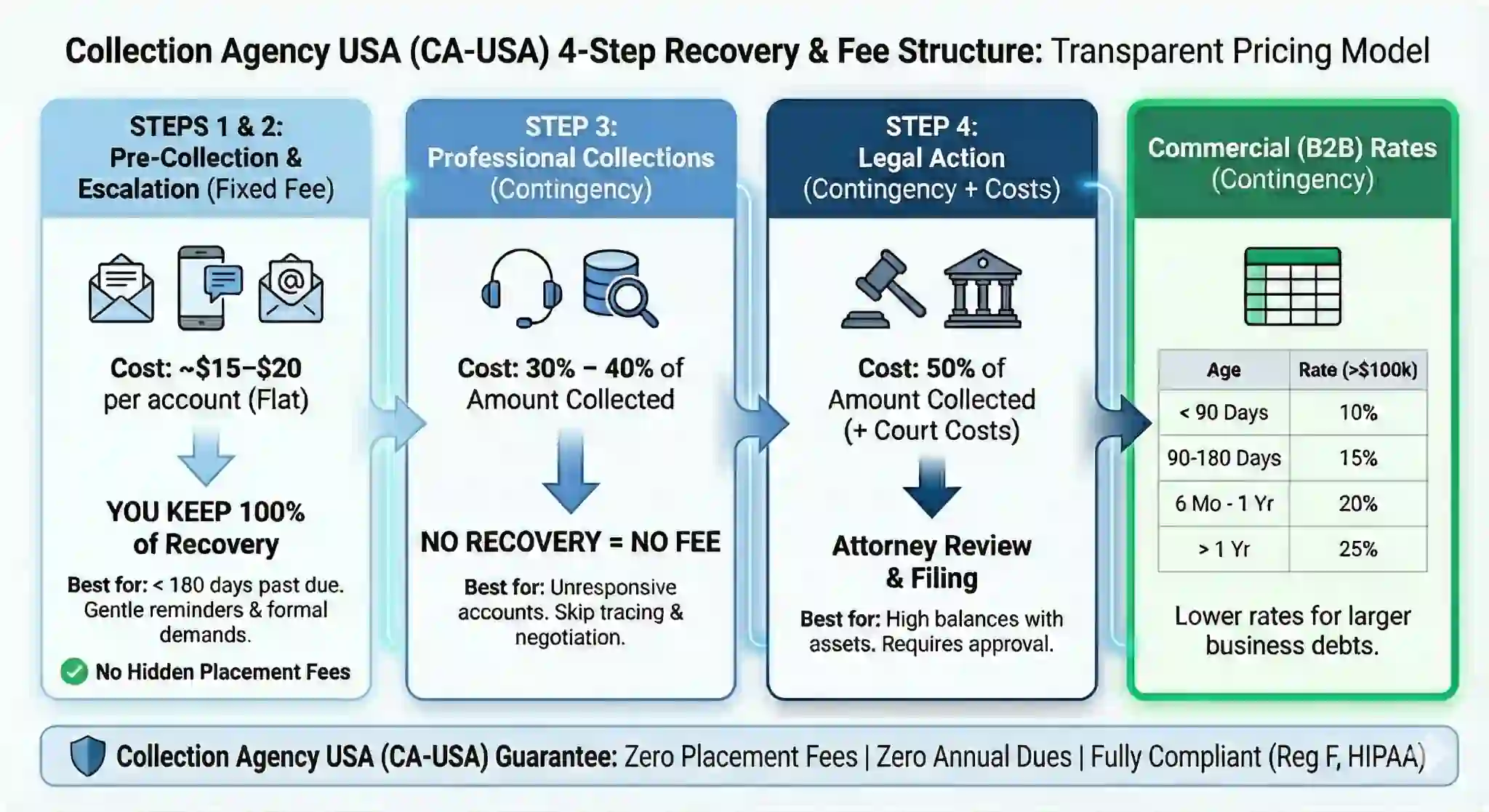
Performance-Based Recovery
CA-USA gives two clean lanes:
-
Fixed-Fee: $15 per account (you keep 100% of what’s recovered)
-
Contingency: 40% (no recovery, no fee)
How We Protect Your Client’s Brand (And Your Reputation)
Most accounts resolve without court involvement. That’s intentional.
We prioritize relationship preservation using cooperative mediation:
-
Calm outreach
-
Clear documentation
-
Direct negotiation with decision-makers
-
Structured payment solutions that feel fair and final
The objective isn’t punishment. It’s payment.
Confidentiality & Professional Standards Note: Account placements are handled under strict data security and privacy protocols to protect client records in full alignment with AICPA professional ethics and confidentiality standards.
The CA-USA Workflow (What You Can Tell Clients With Confidence)
1) Contract & Invoice Intelligence
We gather the paperwork that wins disputes: invoices, signed agreements, POs, delivery proof, service records, emails, and payment history. We also verify business identity and contact pathways.
2) Formal Notice + Multi-Channel Launch
A clean demand notice is sent immediately, backed by documentation you provide us. We use multiple channels to avoid “wrong department limbo” and speed up response.
3) Human-to-Human Negotiation
No robo-calls. We reach controllers, CFOs, owners, and AP managers directly. We isolate the real reason for non-payment—dispute, approval delay, cash timing, or vendor dissatisfaction—and convert it into a firm resolution path.
4) Deep-Dive Verification
If an account gets evasive, we apply practical tools: USPS address verification, skip tracing, and bankruptcy screening. We also run a Litigation Scrub to identify high-risk cases early.
5) Credit Reporting + Pre-Legal Escalation
Where permitted, we offer Credit Reporting to Business Credit Bureaus.
This is a powerful non-legal lever that often produces results without ever stepping into court.
6) Final Lever: Legal Escalation (with your permission only)
If the customer refuses to resolve and the file supports it, we can initiate legal action (with your permission) using our nationwide attorney network —followed by judgment enforcement when appropriate.
Accountants Appreciate This: We Reduce “Hidden Costs”
Aging AR is more than a missing payment.
It’s the hidden burn:
-
Staff time spent chasing
-
Owners distracted from sales and service
-
Uncertainty in cash planning
-
Bad debt that keeps growing quietly
When CA-USA takes over the recovery process, your client regains time and control. You regain cleaner forecasting. Everybody wins.
Quality Controls That Prevent Blowback
Collections failures usually come from sloppy behavior. We guard against that.
-
Calls are recorded and reviewed for compliance and quality assurance
-
We use structured messaging to avoid reputational harm
-
We keep communications professional and documented
-
We avoid “rogue collector” behavior that causes review-bombing or public escalation
This is exactly why CPA firms stick with us. The risk profile is managed.
CPA-Focused FAQs
Can a CPA refer a client to CA-USA without handing over the client’s entire accounting file?
Yes. CA-USA only needs the information necessary to document and recover the receivable.
Typical records may include invoices, statements, contracts, purchase orders, payment history, delivery records, and relevant correspondence.
If the CPA firm is sharing confidential client information directly, applicable professional confidentiality rules should still be considered.
The collection agency needs evidence of the debt—not unrestricted access to the client’s books.
Our CPA firm is owed professional fees. Can we hold the client’s tax records until they pay us?
CPA firms should be very careful.
Treasury Circular 230 generally requires tax practitioners to return records clients need to meet their federal tax obligations, even when professional fees remain unpaid.
That means an unpaid accounting or tax-preparation invoice should generally be treated as a receivables problem, rather than assuming client tax records can simply be withheld.
CA-USA can pursue the unpaid professional fee separately through professional debt recovery.
Why can suing a former accounting client for unpaid fees create more risk than the invoice itself?
Because a fee lawsuit can sometimes trigger a counterclaim alleging accounting errors, missed deadlines, negligence, or work outside the agreed scope.
Before escalating, review:
- the engagement letter;
- scope of services;
- billing records;
- emails and correspondence;
- dispute history; and
- evidence supporting the final amount.
For relatively fresh accounts, CA-USA’s $15 fixed-fee option can provide third-party escalation without immediately turning a billing dispute into litigation.
The aging report says $74,000 is overdue, but some customers have unapplied credits and partial payments. Should those accounts go to collections yet?
Not until the balances are reconciled.
The amount submitted for collection should reflect:
Invoices − payments − credits − deposits − adjustments = actual amount due
A clean $41,700 receivable is far easier to defend than an unexplained $47,300 aging balance.
For CPAs, this is an important advantage: clean accounting records can significantly strengthen the collection file before CA-USA ever contacts the debtor.
Can CA-USA work with information exported from QuickBooks, Xero, Sage, NetSuite, or other accounting systems?
Yes. CPA firms and their clients can provide account data through spreadsheet or ledger exports together with the supporting documentation needed for collection.
This allows a practical workflow:
A/R aging report → reconcile balances → export accounts → securely place accounts → monitor recovery
The objective is to avoid forcing accounting teams to manually rebuild information they already maintain in their accounting systems.
Which accounts should a CPA recommend for fixed-fee recovery, and which should go to contingency collections?
Think of it as an escalation ladder.
$15 Fixed Fee: Best suited to suitable newer accounts where professional third-party intervention may be enough. The debtor pays the creditor directly, so the creditor keeps 100% of the recovered amount.
40% Contingency: Better suited to older, difficult, nonresponsive, disputed, or harder-to-collect accounts. The fee applies only when money is recovered.
A CPA can therefore help clients segment their aging report:
Fresh account? Escalate gently.
Stalled account? Increase pressure.
Difficult account? Move to full collections.
That is more economical than putting every delinquent account immediately into contingency collections.